Showing posts with label Tolkien's Languages. Show all posts

Saturday, 18 February 2017

2017 A Look Ahead


Greetings to all from Valhalla which in the last four months has moved from London to lovely Brighton by the sea.  Wotan never thought he would live 5 blocks from a full blown pier and amusement park - so whenever Wotan tires of working on the various projects that I will be previewing below he can always go and ride on a roller coaster or take a visit to the Haunted Mansion.   

I have not blogged in a while and want to start again to share some of the work I am currently doing on Tolkien, World-Building and various others projects.  


Well 2017 is shaping up to be quite a busy year for Dr. Wotan after his work on the PhD thesis 'The Genesis of Tolkien's Mythology' and co-editing A Secret Vice: Tolkien on Language Invention with Dr. Dimitra Fimi.  I will be giving four papers this year as follows two across the pond in Kalamazoo, Michigan and two at the Tolkien sessions that the brilliant work of Dr. Fimi has established at The IMC in Leeds.   The abstracts I have written for these papers are below and Wotan is busy researching and writing them now! 

Tolkien Symposium at The Western Michigan University Library - 10 May (1-5pm) 


Mapping Tolkien's The Book of Lost Tales: Exploring 'I Vene Kemen'  (The Ship of the Earth) 

One of the unique para-textual elements that Christopher Tolkien published in the first volume of The Book of Lost Tales which is celebrating its 100th Anniversary in 2017 was a map in the form of a viking ship which his father invented as he was writing the first version of his mythology.   In this paper I will examine this conceptual and radical map called ‘I Vene Kemen’ (‘The Ship of the Earth’) from three perspectives.  First, as a key element of Tolkien’s early myth-making;  examining how it is linked to the body of ‘Lost Tales’ he was composing.  Secondly, as a para-textual artefact which reflects Tolkien use of his emerging Elvish languages.  Here I will focus specifically on how the place names on the map reflect the ‘consistent and coherent’ nomenclature Tolkien invented drawn from the Elvish lexicons and grammars he was developing at the time.  Finally, I will examine this map as a key element in the wider process of ‘world-building’ for fiction.  Here I will explore how this map represents the first of many maps Tolkien would invent and integrate into his narratives to build the world of his legendarium.   I will also explore and suggest some possible reasons why Tolkien decided to cast this map in this conceptual form of a viking ship based on his early objective of linking his unique mythology to a lost tradition of England.  

52nd International Medieval Congress - Tolkien at Kalamazoo 
Tolkien and Language Session - Saturday 13 May 

Elvish Practitioners of the 'Secret Vice 

In the course of his life Tolkien explored his thoughts and feelings on the role of language-invention as an interlinked element of myth-making and world-building in two key manifestos: his 29 November1931 talk 'A Secret Vice' and in his inaugural O’Donnell Memorial lecture of 1955 ‘English and Welsh’. Tolkien not only used his mythology to illustrate to his readers how he felt language invention should work in his Legendarium. In several instances within the context of his secondary world Tolkien both mythologized and embedded into the very narrative and discourse of several key mythic texts examples of peoples practicing the ‘secret vice’ of language invention which followed the theories Tolkien explored in the two key manifestos above. In this paper I will critically analyze several texts that Tolkien wrote in the 1950's and 60's (especially the ‘Dangweth Pengoloð' - 'The Answer of Pengoloth') to explore how Tolkien embedded his theories of language and language invention into these texts and also analyse why Tolkien especially had his first-born Elves practice the craft of language invention 'an art for which life is not long enough' (SV, p. 11).  


Poetry and Language Invention: The Interconnected Nature of Tolkien’s ‘The Qenya Lexicon’ and His Early World-Building Poetry.
In the Spring of 1915 Tolkien started the invention of his earliest Elvish language, Qenya, by composing two key documents – ‘The Qenya Lexicon’ and ‘The Qenya Phonology’.  Concurrent with this Tolkien also built his emerging secondary world mainly through poetic composition.  In this paper I will explore the interrelated nature of Tolkien’s earliest language invention and poetic composition from several perspectives. First I will explore how Tolkien included in ‘The Qenya Lexicon’ invented word forms that were designed to make select Elvish words sound more poetic and musical.  Secondly, I will demonstrate through a lexical analysis of some of the key poems Tolkien composed during this time, including his foundational world-building poem of July 1915 ‘The Shores of Faery’, a high corrospondance between the words in these early poems and the base roots and words Tolkien invented in ‘The Qenya Lexicon’; suggesting Tolkien may have been intending to render some of the English poems into Qenya.   Finally I will explore the lexical and grammatical sources of Tolkien’s first Elvish poem ‘Narqelion’ in Tolkien’s ‘The Qenya Lexicon’ showing the strong bond that existed even in this earliest period of Tolkien’s mythopoeia between poetry and language invention .  


'A Secret Vice', the 1930's and the Growth of Tolkien's 'Tree of Tongues'  

In this paper I will explore how after giving us 1931 talk 'A Secret Vice', and as I will argue in several ways because of it, that Tolkien embarked on a new phase of his Elvish language invention by creating his 'Tree of Tongues' that has its conceptual roots in a proto-Eldarin ur-language and through-out the 1930's branched out into over ten different related Elvish languages existing in varying forms of linguistic development.  I will explore how Tolkien's development of this 'Tree of Tongues' drew conceptually upon his training and experience as both a philologist and medievalist and mythically reimagined the real-world attempt by 19th century philologists to reconstruct a similar type of structure for Indo-European languages suggesting it too had a common origin in a reconstructed 'port-Indo-European' language.  I will also explore how this 'Tree' fulfilled the requirement Tolkien explored in 'A Secret Vice' that art-lancs should have a fictional historical background including a sense of hypothetical change over time.  I will explore how Tolkien's 'Tree' is intertwined and interrelated to such key texts from the 1930's including 'The Quenta' and 'The Quenta Silmarillion', 'The First Silmarillion Map', the Annals of Valinor and Beleriand and the two key works on the Elvish languages Tolkien wrote in this period 'The Lhammas' and 'The Etymologies' 

________________________________________________________________________________

Well that should keep Wotan busy but wait there's more!  I am also very busy working on turning my PhD thesis 'The Genesis of Tolkien's Mythology' into a book and also Wotan is very excited that he will be working on a paper for an upcoming publication delving into the Gothic World-Building of the trans-medial diegetic world of Dark Shadows (more to come on this!).  

Talking about world-building one of Wotan's reading highlights this year, so far, has been a brilliant anthology of papers on world-building edited by Mark J.P. Wolf, Revisiting Imaginary Worlds: A Subcreation Studies Anthology for which I wrote a short review of for Amazon.uk giving it 5 stars (quoted below).  This is a must read book for anyone interested in world-building for fiction or any other media.  

'Professor Mark J.P. Wolf’s 2012 monograph Building Imaginary Worlds: The Theory and History of Subcreation (Routledge) was for me, and many others, a revelatory text as it dealt with how imaginary worlds are created in fiction; focusing on the trans-medial elements, in addition to the core narrative, that go into building secondary-worlds. Now Wolf has followed up his brilliant work on the theory behind world-building by bring together a group of leading scholars to explore various elements of world-building in fictional texts as well as physical and virtual environments. Wolf very helpfully divides these papers up into key sections. In 'Worlds on the Rise' three scholars examine different aspects of world-building. Dr. Dimitra Fimi's brilliant paper 'The Past as an Imaginary World: The Case of Medievalism' cogently explores three different author’s - Thomas Chatterton, J.R.R. Tolkien and Umberto Eco - work on inventing an imagined world aimed at representing a medieval past. Fimi puts in-depth focus on the actual process each of these authors used in inventing their versions of medievalism through their making of actual artefacts (forged and feigned documents) as well as constructing narrative transmission schemes to ground these worlds in a sense of reality. Fimi’s re-contextualisation of what has been considered the forgeries of an author like Thomas Chatterton as actually an inventive act of world-building is sure to open up new vistas of exploration around these and related texts. The section called 'Structure' offers a good set of papers exploring the actual mechanics of secondary worlds; ranging from Tolkien's world-building work to that of the role of religion as a world-building element in the television texts Battlestar Galactica and (the short-lived) Caprica as well as the transformational world-building and user reception of Minecraft. In the ‘Practice’ section there are several papers on specific fictional world-building. For me, the two papers on the American fantasy author Frank L. Baum really stood out here. Michael O Riley suggests one of the key sources of Baum's well-known Oz series of books is actually another work Baum wrote in the same year he wrote his most famous book, The Wonderful Wizard of Oz (1900) called A New Wonderland which was overshadowed by the success of the first Oz book. A New Wonderland is a collection of stories that are set in the magical land of Phunnyland. Riley cogent exploration of this ‘lost’ text demonstrates that Baum would use several key elements of Phunnyland in his later Oz books (which itself grew in the series from being a portal world into a fully immersive secondary world) and also explores how prolific a world-builder Baum was outside of just his more well known Oz series. Henry Jenkins provides a good counter-point to Riley’s paper by exploring how the Baum’s Oz mythos was adapted in the recent film Oz the Great and Powerful (2013) which suggested a backstory to the origin of the Wizard by drawing upon elements of not only Baum’s original work put also key adaptations such as the famous MGM Musical The Wizard of Oz and the more recent stage musical Wicked. The series of papers on 'Reception' show how world-building for fiction can be expanded through what Henry Jenkins has called 'multi-media layering.' A good example is the extension of a fictional world coming from film or television through novelizations. William Proctor and Mathew Freeman's paper examines the very recent debate in the Star Wars mythos of what in the many novelizations of the original films is considered ‘canon’ to Lucas’ original world-building and what is now what Disney has been deemed ‘legendary’ as it no longer fits the diegetic braiding of the ‘official’ world-building of the Star Wars mythos. Gerald Hynes masterfully explores the role of language in the world-building of China Mieville’s Embassytown showing how the world-building element of language, either actually shown (as in Tolkien’s great work) or just described, has the power to shape conceptual domains and ground a secondary-world in a great sense of reality. After offering these brilliant papers this volume ends with a paper by Wolf himself suggesting a canon of Imaginary Worlds ranging from Kallipolis in Plato’s Republic (c. 380 BC) to the Utopia of Thomas More (1516 – the first fictional text to include elements of invented language and a map!) up to Wonderland, Flatland, Oz and of course Tolkien’s Arda – and beyond. One could just revel (and in these scary times in the primary world) escape into these worlds – and thanks to the continued work of Wolf (his bio shows more work on world-building is coming from him!) and the scholars who have contributed to this volume we now have a better understanding and exploration of how these worlds are built, grow, are received and thrive in our multi-media and multi-layered culture. I highly recommend this book and look forward to many more explorations.'
Well Hugin and Munin are whispering in my ears that I should stop writing this blog and actually get to work on the projects above - so Wotan will leave you now and will return with more news and thoughts from Valhalla by the Sea.  

 Lebe Wohl for now!   


Sunday, 1 March 2015

Well....I am Back!


Mae Govannen!  Roughly three and half years ago Wotan left Valhalla to go on an incredible journey - an exploration of the world of J.R.R. Tolkien's earliest mythology.   With the incredible support, guidance and mentorship of Dr. Dimitra Fimi (my 'Gandalf' who appealed to my Tookish side of academic exploration and got me on the road!) I have now completed this quest and returned to my new Valhalla (looks like Fafnir and Fasolt have built me a new office - hope I don't have to give them Charlie the Wonder Corgi as otter-ransom).  

This Thursday in Cardiff I successfully completed my PhD thesis 'The Genesis of J.R.R. Tolkien's Mythology' and am now Dr. Andrew Higgins - a title I accept with humility and an unswerving ambition of wanting to do as much work and scholarship in the areas of Tolkien, fantasy literature and secondary world building in the years ahead....

The Genesis of Tolkien's Mythology - My PhD Quest 

The researching and actual writing of a PhD thesis on the early creative thought and mythology of J.R.R. Tolkien (a quest I highly recommend to all - whatever area you choose) has to be one of the most incredibly fulfilling, rewarding and, at times, frustrating projects I will ever undertake on this side of the great sea.   It is amazing to focus almost 24/7 on an author's emerging creative process - my research chose to critically examine the earliest creative work of J.R.R. Tolkien (up to the 'Book of Lost Tales' materials), from which the first version of his mythology would emerge, as one coherent whole, rather than a series of individual creative acts.  The thesis argues that all aspects of Tolkien's creativity worked in a dialectic way to bring to life an invented secondary world the complexity of which fantasy literature had not seen before.  In the next year or so one of my key projects will be working on turning the thesis into a book.  Hopefully in the not too far future I will be able to share with you my take on how Tolkien achieved the development of this earliest version of his secondary world.

The PhD viva itself was quite an experience and one of the most exhilarating robust academic dialogues I have had about the research.  When you are doing a PhD you are pretty much in what I call 'the thesis bunker' researching, writing and discussing your work mostly with your PhD supervisor - and in my case I was very lucky and fortunate that this meant spending many hours in discussion with Dr. Fimi whose incredible thoughts, feedback, patience (with my 'nigglings') and insight into this material was so important and valuable to me - there is none better! 

Being able to actually discuss the research with other academics (after three and half years of developing it!) was really rewarding.  I had a mock viva in December with an internal team at Cardiff Metropolitan University which helped me focus on some wider issues of the research.  Like in any quest,  I also had some amazing helpers along the journey who read chapters of my thesis and gave me incredibly instructive comments.  I was very fortunate to have the help of Tolkien scholar Douglas A. Anderson (who read an early version of the thesis and steered me in the right direction in terms of some of Tolkien's early work and dates) and then my thesis chapter readers: Dr. Verlyn Flieger, John D. Rateliff, Gerard Hynes and Dr. Simon Eckstein (whose own thesis work was an inspiration!).

For the final viva at Cardiff Metropolitan University last Thursday I was very fortunate to be examined internally by Dr. Kate North and externally by Dr. Mark Atherton - Lecturer in English at Regent's Park College, Oxford and author of There and Back Again: J.R.R. Tolkien and the Origins of the Hobbit.   This was an amazing session with some really constructive dialogue, debate and helpful feedback and comments that will go into the final thesis, which I submit in the next week, and also will feed into my work into turning this research into a book.

The only bittersweet element to achieving the PhD (very fitting for anything having to do with Tolkien) was that my Dad - having taken the ship to the West last year - was not there to see it.  In the acknowledgements of the thesis I paid tribute to my Dad who had a passion for Tolkien and introduced me to the 'arresting strangeness' of the world Tolkien built which had so impacted my Dad's life and subsequently mine.  I hope one day in the West my Dad and I can both discuss this research (he would have much to say I am sure!) - Nai hiruvalme Valimar! 

Upcoming Projects and Papers

To somewhat para-phrase Gandalf the achieving of a PhD is 'not an end' it is only the beginning.  As I remember in one of the many books on 'doing a PhD' I read over the last three years someone once said the PhD is not your 'masterpiece' it is what you do with it (wise words).   Indeed I return to Valhalla from my academic wanderings with quite a comprehensive list of projects that I will be working on - several of which have come out of, or been inspired by, strands of the research I have done.  

Currently I am scheduled to give the following papers at three key conferences coming up in 2015: 

The Enchanted Edwardians Conference 
Bristol 
29-30 March 2015 

I will be giving a paper on 'O World Invisible We View Thee' - The Syncretic Nature of Francis Thompson's Visionary Poems.   

At this conference Dr. Fimi will be giving a paper on 'Kipling and Tolkien and their "mythology for England" 

More info here 

50th International Conference of Medieval Studies 
Kalamazoo 2015 
May 14-17 2015 

This will be my second time taking part in the 'Tolkien at Kalamazoo' sessions in the company of many brilliant Tolkien scholars and academics. 

I will be giving a paper as part of the 'Tolkien as Linguist and Medievalist' Panel on 'The First Red Book - A Exploration of Tolkien's Exeter College Essay Book' and will also taking part in the live reading of Tolkien's Beowulf 2014 (practicing now as I re-read this important text for the current excellent 'Beowulf through Tolkien and Vice-Versa' course with Professors Tom Shippey and Nelson Goering) 

International Medieval Congress Leeds 2015 
6-9 July 2015 

Dr. Fimi has organised a series of Tolkien related sessions at this year's IMC Leeds 2015 and I am very excited to be giving a paper as part of the session on 'Celtic Literature in Tolkien's Medievalism' which includes some other excellent speakers including my Mythgard Institute colleague Kris Swank.  
  • Tolkien, Brendan, and the Quest for The Lost Road (Aurélie Brémont, Centre d’Études Médiévales Anglaises (CEMA), Université Paris-Sorbonne – Paris IV)
  • Immram Roverandom (Kris Swank, Pima Community College, Tucson)
  • Welsh Princesses and Cats: Tolkien’s Tale of Tinuviel and The Gnomish Lexicon (Andrew Higgins, Cardiff Metropolitan University)
Other sessions will include papers by Dr. Fimi, Dr. Mark Atherton and Nick Groom whose work includes a brilliant chapter 'The English Literary Tradition: Shakespeare to the Gothic' in the 2014 Blackwell Companion to J.R.R. Tolkien.   

Dr. Fimi has more information on IMC Leeds 2015 on her blog posting here. 

In addition I have started to use Academia.edu for papers and book reviews and will continue to post there as papers are written and delivered.  There is an amazing treasure trove of academic resource to be found on this site.  

In January 2015 I launched a monthly Tolkien language column on The Signum University Newsletter 'The Signum Eagle' called 'In Dembith Pengoldh' through which I will explore elements of Tolkien's language invention. 

Wotan will use this blog to update on all activity and also explore some key areas of interest around Tolkien, fantasy literature and especially emerging scholarship in secondary world building and, for Wotan, the link to language invention.  

Glad to be back in Valhalla - and now to work - lots of papers to write!  

Dydd gwyl Dewi hapus! and Namárië for now! 


Sunday, 27 March 2011

-Turambar and the Foaloke - Etymological Archaeology


In honour of Tolkien Reading Day (which for me has become a Tolkien Reading Weekend), this posting is based on my current re-read I am doing with a group called The Tolk-Lings whose objective is to read the entire 12 volume History of Middle Earth - one chapter a week (anyone can join along!). We are now in the heart of the great epic tales that make up the second book of Lost Tales around Beren, Turin and the Fall of Gondolin.


In the course of this re-read I am paying very close attention to what I am calling "etymological archaeology" that is a structured examination of the very earliest strata of Tolkien's linguistic development of the languages that form the great languages (Quenya, Sindarin, etc) of the legendarium. Along with the re-read I am also casting a foresnic eye on the two accompanying works - The Qenyaqetsa and The Gnomish Lexicon both published through the excellent linguistic journals Parma Eldalamberon by the Elvish Lingustic Fellowship.


This week what struck me in the re-read of Lost Tales 2 -Turambar and the Foaloke - the earliest version of the Turin story that would later become the great epic works of Turin Turambar - was in a passage given by Christopher Tolkien in the notes to the chapter. Christopher writes that in the notes for the original story, he was able to decipher a pencil outline for a very early version of the Turin story that was NOT erased (one of the few cases when Tolkien did not erase the pencil layer!) -


"Tiranne and Vainoni fall in with the evil magician Kuruki who gives them a baneful drink. They forget their names and wander distraught in the woods. Vainoni is lost. She meets Turambar who saves her from Orcs and aids in search for her mother." (History of Middle Earth, Lost Tales 2, p.138)


Christopher calls this unerased pencil version "a layer in the Turin saga older even than the erased text underlying the extant version." We know that Tolkien began work on Turambar and the Foaloke in 1917.


In this pencil passage we have three names that do not survive into the finalized version of Turambar or any of the later works and thus are of interest from an archaeological etymology point of view. In the notes, Christopher makes parallels from the penciled names to the final ones in Turambar and the Foaloke:


Tiranne - Mavwin (Mother of Turin later Morwen)

Vainoni - Nienori (sister of Turin)

Kuruki - possibly the dragon Glorund/Glauring


(Lost Tales 2, p.139)


The sources of two of these names - Vainoni and Kuruki - do appear in another very early work of Tolkien based on his study and love of the Finnish National Epic The Kalevala. Thanks to the excellent work of Tolkien Scholar Verlyn Flieger we now have Tolkien's original story of Kullervo from 1914 and his essay on the Kalevala (found in Tolkien Studies 7). Flieger writes in her introduction how it was Tolkien's very focus on turning one of the stories from the Kalevala (Runos 31-36 Kullervo) into "a short story somewhat on the lines of Morris romances which chunks of poetry in between" (Flieger, p.211). Tolkien considered this work the very germ of the Silmarillion and it later became the basis for the story of Turin Turambar.


Through a combination of encountering the Kalevala (in Kirby's English translation of 1911) and finding a copy of C.N. Elliot's Finnish Grammar Tolkien became absorbed by study of the Finnish language and myth - indeed the very notebook that Tolkien started to use to sketch a Germanic/Gothic based language became the same note book that he sketched the more Finnish based "Qenya" language - one of the two key languages in the early parts of the legendarium (Parma 12, ix-x)


But before working on an original story based on Kullervo (which became Turin)- Tolkien rewrote the legend of Kullervo from the Kalevala - developing his own story with new characters (including a pre-Huan dog companion called Musta (A good Finnish name for a dog Blacky) and inventing new names for the characters. Flieger makes a note that some of these names echo or prefigure Tolkien's earliest efforts at his invented language - Qenya (Flieger, p.213).


So back to those three names from the early penciled version of Turin and the Foaloke


KURUKI


It is in Tolkien's retelling/reconstruction of Kullervo that we first find the name KURUKI (the evil magician). There is a list of names that accompanies the work that includes the names - KURUWANYO, KURU - The great black river of death. The notes for this indicate that Tolkien may have formed this name from the Finnish word for death - KUOLEMA (Flieger, p.244) Interestingly, there is a Finnish play called Kuolema written in 1903 by Arvid Jamefelt which has incidental music by the writers brother in law Jean Sibelius which is about death visiting a home. The word comes into the Qenya Lexicon where we find Tolkien has transformed the root of this word KURU to mean magic or wizardry with the name KURUVAR meaning wizard (PE 11, p.28). It also has associations with sin, wickedness and evil (CURDHU). Later in The Etymologies, this root KUR becomes "craft Q. KURWE craft, N CURW, CURU; CURUNIR wizard; cf Curufin, CF N CRUM, wile guile, CORW cunning, wily (Lost Road, p. 366) Interestingly there is an added entry "N CRUM was rejected; see KURUM" Lost Road, p. 366). KURUM is glossed as "N. CRUM the left hand, CRUM left, CRUMI left-handed Could there be an association one can draw between crafty, cunning and left-handiness - the idea of the left having a slightly sinister side (as in the very Latin word for left SINISTER and those nuns who used to whack left handed writers till they changed to their right hand?). So in its possible Finnish origin and its later early Qenya association we see Tolkien combining the idea of death (which indeed is what the "baneful drink" ultimately does for Turambar and Vainoni) and the idea of wizardry and cunning. Later of course the Istari Curunir (Saruman) is bound up very much with both evil and death.


VAINONI


The early pencilled version of Turin Turambar's sister Nienor/Niniel whose name means "mourning" or "tear maiden" Vainoni is close to the name Tolkien's uses in his original tale of Kullervo - WANONA (once mentioned as WANORA) which is a name of Tolkien's own creation - in the original Kalevala the sister in not named. Another suggestion of "water" might be in the Elvish stem of the name VAI - which is the name of the outer ocean - but that might be a bit of a stretch. In the Gnomish Lexicon, there are several words with the root GWAN meaning beautiful, fair and there is GWANN who is glossed as a Valsi of dancing, joy, spring, life and beauty (PE 11, p.44) - quite an ironic potential source for a character who meets such a tragic end.


TIRANNE

An elusive name that does not appear in any of the early Finnish works. Tiranne is the name for the mother who would later become Mavwin in Turambar and the Foaloke and in later versions Morwen (dark hair and tall - with the MOR the root for dark). This is a tricky one to source. In both the Qenya and Gnomish Lexicons the root TIRI is associated with watching, looking for, looking out for (PE 12, p.71) and one can certainly argue that Tiranne/Mavwin/Morwen spends a lot of her time waiting and watching for her husband, Urin/Hurin, who was captured in battle by Melkor as well as waiting for her son Turin. I have yet to find a link with this in Finnish. Tirana is the capital of Albania and I have yet to find any connections here!

So here we have three examples of names Tolkien constructed based on his very early work with the Kalevala and his love of Finnish - not just translating the Kalevala but using the phonology of Finnish and his "elvish craft" to construct new names - names that later found there way into the early versions of his legendarium. Luckily due to Tolkien not putting the eraser to this very early strata of the Turin story we are able to see some of his earliest thoughts and influences on the development of the legendarium - and I will be keeping a "Gwahir" eye on other ones throughout this study of The History of Middle Earth.


Sources Used:


Tolkien, J.R.R. The History of Middle Earth (volume 1) HarperCollins: 2002


Parma Eldalamberon XI - Tolkien J.R.R - The Grammer and Lexicon of the Gnomish Tongue The Tolkien Trust:1995


Parma Eldalamberon XII - Tolkien, J.R.R - Quenyaqetsa - The Qenya Phonology and Lexicon - The Tolkien Trust: 1998


The Story of Kullervo and Essays on the Kalevala by J.R.R. Tolkien (edited by Verlyn Flieger) in Tolkien Studies Volume 7, West Virgina University: 2010


Saturday, 29 January 2011

Langon - The Mouth of Melko - Some Etymological Detective Work


In a recent post to the Lord of the Rings Fanatics Plaza, Jason Fisher did an excellent piece on hapax legomenon in The Lord of the Rings, words that only appear once. I've been thinking about a similar exploration for names that only appear once in The History of Middle Earth and have found my first candidate.

In the Book of Lost Tales I, in Meril-i-Turnqui's tale to Eriol of "Melko's Chains" we hear of the great assault on Melko in his fortress by the
Valar lead by Manwe, Orome and Tulkas. When Melko hears Manwe's command to come forth he does not but...

"he would not come, but sent Langon his servant and said by him that...." (Lost Tales 1, p 102)

The name leapt out at me as he is one of the first named servants of Melko we hear about (long before Sauron) I wondered where this name and character came from. A check of the main HOME index indicates this is the only time in the entire legendarium that this servant of Melko is mentioned - so a true hapax legomenon.

The key to his name is the "said by him that...." Langon is essentially the voice of Melko.

But whence the name???

In the i Lam na Ngoldathon (The Gnomish Grammar and Lexicon 1917) developed by Tolkien in concert with The Book of Lost Tales (and published as Parma Eldalamberon XI) there are two revealing entries:

-LANG- to blare, clang, ring
-LANGON- great bell

(P.E. XI, p. 52)

So perhaps the name has something to do with Langon "blaring forth" Melko's message of "behold he was rejoiced and in wonder...." (Lost Tales I, p. 102)

But a more compelling case, and indeed perhaps in this case it was nature of the character which influenced the etymological development of the word, comes later in The Etymologies with this passage -

LANK - Quenya lamba throat, N lhame [The Stem was first written LANG, with derivatives, Q langa (*langwi), N lhang,, see LAK" (Lost Road, p. 367)

LAK - swallow, Q lambo throat (Lost Road, p. 367)

And in the Quenya corpus this word and meaning is found in the Quenya poem Earendel which was published by Christopher Tolkien in the essay A Secret Vice in Monsters and Critics

" San ninqeruvisse lútier
kiryasse Earendil or vea,
ar laiqali linqi falmari
langon veakiryo kírier;

Then upon a white horse sailed Earendel, upon a ship upon the sea, and the green wet waves the throat of the sea-ship clove. (MC, p. 216)

So Langon indeed is the mouth/voice/throat of Melko and while this early servant of Melko is not mentioned again in the legendarium - his actual role in this case may have influenced the development of this word and its place in the Quenya lexicon and corpus

Langon also reminds us of a later Mouth - namely the Mouth of Sauron

"At its head there rode a tall and evil shape, mounted upon a black horse… The rider was robed all in black, and black was his lofty helm; yet this was no Ringwraith, but a living man. The Lieutenant of the Tower of Barad-dûr he was, and his name is remembered in no tale; for he himself had forgotten it, and he said: 'I am the Mouth of Sauron" (Return of the King, The Black Gate Opens)

It is interesting in both the cases of Langon and the later unnamed "Mouth of Sauron" we know very little about them. in The War of the Ring we learn a few details about who the Mouth of Sauron might have been (War, p. 431) but no full biography and no name.

So perhaps when Tolkien was developing this Emissary of pure evil in The Lord of the Rings he thought back to this earlier servant Langon - the long forgotten voice of the first Dark Lord?


Saturday, 8 January 2011

"Where Even Now the Peacocks Pace a Stately Drill"

Another small snippet from the exploration of the first chapter of Tolkien's The Book of Lost Tales One, The Cottage of Lost Play. In this Chapter Christopher Tolkien includes various versions of his father's poem Kortirion among the Trees. All three versions include the line

"Where even now the peacocks pace a stately drill"

As we learn in this chapter in the original version of Lost Tales The seafarer Eriol comes from the ancestral home of the English to the lonely island which is England. Where he hears the story of the fairies and elves is Kortirion which will later become Warwick (Lost Tales I, p.25).

Well I was in Warwick last year and took this picture - I guess the peacocks persist although not sure if it is pacing a stately drill!!!


Posted from Andrew Higgins IPAD asthiggins@me.com

The History of Middle Earth - A Chapter by Chapter Exploration

Some former students (including yours truly) of Dr Dimitra Fimi's excellent
Tolkien Myth and Middle Earth in Context through the University of Wales (UWIC) have banded together as a group called the Tolk-lings to start a chapter by chapter exploration of the twelve volume bedrock of Tolkien scholarship The History of Middle Earth. Thanks to Dr. Fimi and UWIC we have been given permission to use the UWIC Fantasy literature discussion board to explore and discuss each chapter and very excited with the group of UWIC students and others who are joining in
(and anyone can join as well)

Another thread of this blog, in addition to Wagner and Tolkien, will be some key observations On The History of Middle Earth as I journey chapter by chapter through it with a specific focus on the development in the legendarium of the language system of the Elves and Men (we have now received our first glimpse of the language of the first men, Taliska is Parma Eldalamberon 19)

So here is my first posting on the first chapter of Book of Lost Tales One - The Cottage of Lost Play


Tolkien's Early Concept of the Olore Malle - The Path of Dreams

So much in the opening chapter so where does one start? Well, one concept that has always interested me mainly because it is introduced in this chapter and then slowly fades away (or does it) is the Olore Malle - the pathway of Dreams on which mortal children travel to Valinor in their dreams as Tolkien illustrates in the poem "You and Me and The Cottage of Lost Play (Lost Tales I, pp 28-31). As Christopher Tolkien says the entire conception of the Children who went to Valinor was to be abandoned almost without trace (Lost Tales I, p. 27) with only two other major references to it throughout the rest of the Book of Lost Tales. So this was a very early concept of travel into faerie through dreams which Tolkien brought into the development of the Book of Lost Tales and then "abandoned.". One of the most fascinating aspects of the Book of Lost Tales, for me, is even at this earliest point in the formal development of his legendarium, Tolkien had already developed a body of poetic works about his early world. John Garth's excellent Tolkien and the Great War and Dr Dimitra Fimi's award winning Tolkien, Race and Cultural History are key sources for charting the development of these pre Book of Lost Tales works and their influences. As Dr Fimi indicates an important early influence of Tolkien and the specific development of the Olore Malle was J.M Barrie's Peter Pan which Tolkien saw as a child. Dr Fimi indicates that the idea of children coming and staying in fairy land parallels the story in Barrie's Peter and Wendy in which reference is made to Peter Pan living with the fairies and who when children died accompanied them part of the way so they would not be frightened (Fimi, p.37). So this early concept comes out of the Edwardian and Victorian fairy tradition that soon faded, as did this concept, in the harsh light of the aftermath of World War One. But did it? Actually the concept of "travel" in dreams to faerie actually persists in Tolkien's writings as we will see later on in his time travel stories The Lost Road and The Notion Club Papers.

I was also struck on this re-read by how much of the atmosphere of the hall found it's way into the Hall of Fire in Rivendell where great tales are also told.

Works Cited

The Book of Lost Tales 1 in The History of Middle Earth (Part 1), edited by Christopher Tolkien. (London: HarperCollns: 2002)

Fimi, D (2010) Tolkien, Race and Cultural History: London: Palgrave


Also stop presses!!! Professor Corey Olsen otherwise known as The Tolkien Professor has announced a new course which he will make available for iPod listening called Faerie and Fantasy .

His course last year on Tolkien's major works was brilliant and I think a key event in Tolkien scholarship and looking at the reading list which includes Middle English literature, Chaucer, Dunsany, Lewis, Tolkien and more looks really exciting.

Professor Olsen should receive one of the rods of the Istari for opening up and allowing exploration of the works of Tolkien and others to international audiences!! I will be reading and listening along to this one.


Posted from Andrew Higgins IPAD asthiggins@me.com

Saturday, 11 December 2010

Tolkien Studies for 2011

Habt Acht! Wotan is returning soon. In 2011 he will be exploring several areas of Tolkien Scholarship and will try to be faithful to his readers!!!

just received the new copy of Parma Eldamberon 19 which I am going through. first evidence of Tolkien's first age Taliska language which this blog will seek to analyse. More to come!!


PARMA ELDALAMBERON 19

Quenya Phonology:
Comparative Tables
Outline of Phonetic Development
Outline of Phonology

By J. R. R. TOLKIEN

http://www.eldalamberon.com/parma19.html

Quenya phonology is a topic frequently discussed or alluded to by this group; and indeed a great deal is known about it, based on incidental statements made by Tolkien in various contexts and on inferences drawn from the evidence of attested examples of Quenya. So I hope it will be welcome news that Tolkien's own writings about this topic dating from the time of his composition of _The Lord of the Rings_ have now been published in _Parma Eldalamberon_ No. 19.

The "Outline of Phonology" is a comprehensive survey of all of the sounds and sound-combinations that occur in Quenya, including the divergences among the Vanyarin, Noldorin and Telerin dialects of the language, and variations over its recorded history such as those between _Parmaquesta_ or 'book-language' and _Tarquesta_ 'high-speech'. The sounds are all traced to their origins in Common Eldarin; and this forms the basis for the organization of the "Outline," which has sections on Consonants in Isolation, Initial Consonant Groups, Medial Combinations of Sounds, and Consonants Standing Finally, along with a section on Vowels that was left uncompleted. The text was composed around the time Tolkien began his revision of _The Silmarillion_ in 1951, and includes additions and emendations from certainly as late as 1959 and probably later; so it reflects the conception of Quenya that has come to be termed "LotR-Era" insofar as the writing is presumably intended to be consistent with Tolkien's published fiction.

The "Outline of Phonetic Development" is an earlier version of essentially the same survey, probably composed around the time of _The Etymologies_. In this text the part dealing with Vowels was completed, and it includes sub-sections on Changes Due to Accent and Stress, and Changes Produced in Hiatus.

The "Comparative Tables" are a series of charts laying out the regular correspondences among the sounds of the various languages Tolkien had invented by the late 1930s or conceived of as part of his history of the Elves, including Valarin, Quenya, Lindarin, Telerin, Noldorin, Ilkorin, Danian and Lemberin, as well as the Mannish language Taliskan. These are accompanied by Tolkien's notes on the general phonetic characteristics of the historical development of the languages, and on their phonological types in terms of the "real" languages on which
.

__,_._,___

Sunday, 28 June 2009

Great New Book about Con-Languages


One of the reading joys of this summer (thanks to the Amazon "we think you would enjoy option") is a new book about the world of artifical languages (or con-langs) called In the Land of Artifical Languages by Arika Okrent.

As an avid although I fear hoplessly inept Tolkien Linguist I was not aware of the incredible number of artifical languages and the number of people who had the same "secret vice" as Tolkien. The book is excellenty writen with some great tongue and cheek observations of a newbie at at a Loglan conference or cramming to pass her first test in Klingon (which I am now secretly -will not so secretly if I am posting it here! - thinking of learning once I get my head around Russian.

I recommend it highly! My Good Reads review follows:

In the Land of Invented Languages: Esperanto Rock Stars, Klingon Poets, Loglan Lovers, and The Mad Dreamers Who Tried to Build A Perfect Language In the Land of Invented Languages: Esperanto Rock Stars, Klingon Poets, Loglan Lovers, and The Mad Dreamers Who Tried to Build A Perfect Language by Arika Okrent


My review


rating: 5 of 5 stars
Excellent book - a must read for any secret vice arm chair linguist - has made me interested in learning Klingon!!! Excellent - a bit more on Tolkien would have been good - perhaps a second volume.


View all my reviews.

Sunday, 16 November 2008

Glyndebourne On the Big Screen(s) and Some New Tolkien Linguistic Goodies!!!

Its been a while...but I have been busy in the opera front. I write today about two exciting and very different initiatives of note:

Glyndebourne on Screen
- this is an exciting new intuitive we have at Glyndebourne that is bringing some of our Glyndebourne opera productions to cinemas throughout the UK, United States, Europe and Japan. Now you can experience our current productions of Handel's Giulio Cesare (in a landmark production by the visionary opera director David McVicar), this summer's hit Hansel and Gretel and Rossini's Cenerentola in stunning high definition 5.1 stereo surround sound. The experience of seeing opera on a large screen o is a unique one - where else can you see a really tight close up on a singer as they are performing such a moving aria as Cleopatra's - Lascia ch'io pianga and Da Tempeste sung exquisitely by Glyndebourne's Cleopatra - the excellent Danielle De Niese.

And if you can't get to one of the close to 100 cinemas we are appearing at - you can also view excerpts from the operas on Telegraph TV iincluding the ability to embed these clips and email them to friends - a great way to get an opera party together to go to one of the Glyndebourne Screenings!!!! Here is an example of what you can experience:


On another completely different front - after the excitement of the publishing by the Elvish Linguistic Fellowship of Parma Eldalamberon 17 containing Tolkien's guide to all the "foreign" words in Lord of the Rings there has been a bit of a pause in Tolkien linguistic analysis for the summer. Now the autumn (when it grows dark and there is more time for reading ans study) heralds forth two excellent works for study - the first is the published version of Thorsten Renk's Pedin Edhellen Sindarin Course which has been available as a PDF for some time but can now be purchased as a book to save one from killing many trees by printing out the work. I am half way through and I find his development of an actual course on Sindarin very well constructed with careful consideration (shaded in grey) for areas that are asterix conjecture - it also incorporates findings made from PE 17 including a much more fleshed out version of Tolkien's concept of the verb "to be" and personal pronouns.

Over at E.L.F - they have posted on a new article on their online journal Tengwestie by Helios De Rosario Martinez called Early Ilkorin Phonology. This article analyzes the develop of one of Tolkien's "minor" languages which he developed in the early phase of the development of his mythology - starting with the Book of Lost Tales and into the period when he was at the University of Leeds. Ilkorin is the language of those elves who "never saw the light of Kor" and therefore represents Tolkien's thoughts on that language who lingered in Middle Earth and did not have their tongue mingled with the Valar and/or Elves on the West. In the article Martinez states that Ilkorin was most likley a series of languages that included the language of Doriath (the language of Thingol and Melian).

It is quite interesting to see how Tolkien potentially modeled the phonological and morphology of this language and the development of proto-Germanic including parallel vowel shifts in key stages of its development. Martinez also states in his conclusion that "Ilkorin was supposed to be the germ of the languages of Men and that it changed less than the other tongues of the Elves." This got me thinking about one of Tolkien's languages that I am most interested in - the first language of Man - Taliska - which according to what we know about the language was based on Tolkien's love of Gothic. I did query this to Lambengolmor - the Tolkien linguistic mail group -and was told by ELF editor Carl F. Hostetter that we should revisit this question when the information on Taliska is finally published - Carl indicated that he was working on editing this but that it was going slow (I volunteered to help) - so perhaps in the near future we can compare the language of Taliska with Ilkorin to see how much the Elves who stayed in Middle Earth in the first age had an impact on the development of the languages of Men - the languages we speak to this very day!!

The Tolkien books keep coming - and I am eagerly awaiting my order of The Proceedings from the 2005 Tolkien Society Conference in Birmingham which seems to be coming via Entish post!!!!

Friday, 28 December 2007

Looking forward to the New Year

It was certainly a busy autumn professionally and especially with the start of a new job in a new arena for me I did really start to feel the way Tolkien felt when he tried to fit in all his work on languages and Middle Earth into a busy schedule and keeping a roof over his families head and food on the table. So I am looking forward to 2008 because besides keeping up studies in Old English, Old Norse, Welsh, Greek and Latin (currently in play with Harrius Potter 1) I also want to embark on learning the oldest Indo European languages - Hittite and also get more of Tolkien's languages under my belt.
The recent publishing by the invaluable Elvish Linguistic Fellowship of Parma Eldalamberon 17
A Guide to Names and Places in Lord of the Rings has opened up a lot of new information on the key languages and I have just given this one read - so I will be tucking into this more and developing some key models for the languages.

I am currently reading a first edition translation of The Ancrene Riwle (Ancrene Wisse) which my partner gave me for Christmas. This is the edition by M. Salu who was a student of Tolkien. The Ancrene Riwle is a guide for female nuns and was written in the 12th century in the midlands (Tolkien has a keen linguistic interest in this due to the Early Middle English (Semi Saxon as he called it) midlands dialect it was written in. It was most likely written by a student priest and exists in several versions which go all the way up to the 15th century. One of the key messages that I have seen at the outset is the idea of being physically and morally "pure" to have a truly contemplative relationship with God. Of course a lot of the Riwle is about how to ward off those terrible evil impure thoughts (all those nuns together - reminds me of that scene in Monty Python's Holy Grail with all the maidens in Castle Anthrax!) - should be an interesting read.

There's also a new spate of Tolkien books to read and I am (as Professor Simon Schama so beautifully put it on a recent Radio 4 podcast) about to set off on the grand voyage with the new translation of War and Peace which is sitting on my bedside table waiting to be opened.

So it looks like its going to be a fun interesting year and with my new WIFI mini laptop I should get more postings in!!

Monday, 23 July 2007

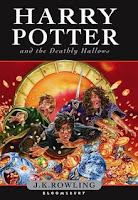
HP and the Deathly Hollows!

My partner and I purchased Harry Potter and the Deathly Hallows at midnight on friday night and finished yesterday afternoon. I am not giving anything away! I thought it was the best of the seven and J.K. has done an incredible job with the story and the characters. There are more twist and turns than I have read in a novel in a while and the emotional range was staggering. Bravo! Well worth it. I only hope somewhere in J.K.'s notes there is a some materials for an Harry Potter Silmarilion!! Be interesting to debate the points - love to get into the horacrux and Tolkien's ring - once we are all prepared to discuss.

On the Tolkien language front - I think I am going to take a bit of a u-turn and start doing some prose translation - perhaps of Tolkien's Of the Rings of Power and the Third Age....of course with the way things are going in the UK it might be better to get do the The Downfall of Numenor (I feel the flood waves a comin!).

Sunday, 15 July 2007

Turin and the Dragon - Lines 39-44 and another Tolkien language

Some time this weekend to resume work on the Sindarin translation of Turin and the Dragon - here are lines 39-44 -

Dan dur din aun Morgoth Bauglir
in na ruith um gwennen
u-sint*
Ethir din, hur um egor galu en golu din
u-aunant siniath en gardh
in gwaith en Golodhrim bant

but the triumph he turned to doubt
of Morgoth the evil whom mad wrath took
Nor spies sped him, nor spirits of evil,
nor his wealth of wisdom to win him tidings
whither the nation of the Gnomes was gone.

*u-sint: based on the verb _ista_ (know) and the _u_ not. I found a gloss on a German Sindarin site for the word _zweifel_ which is _trass_ but can not find any source for it (yet) in Tolkien.

Just when you thought you have read about all of the languages Tolkien developed comes a new one (for me) - and that is Mago/Magol which is mentioned in the notes to book two of The History of the Hobbit (excellent book). Mago/Magol was developed by Tolkien based on, according to the ELF panel, Hungarian. At one time he intended to have the orcs speak it but decided not to. ELF promises that his grammar and notes for Mago/Magol will be published in the future. In a great email Patrick Wayne sent in response on the Labengolmor list (#1012) he said the language would have the sound of Elves who lived in Budapest!! Should be interesting - but first Taliska (I hope)...over and out.

Thursday, 28 June 2007

Turin amd the Dragon - Lines 35-40

This will probably be the last post for a week as I will be taking the first part of my holiday to North Wales (The Grey Havens) probably with the History of the Hobbit vol 2 to read on the beach (or the floods based on what is currently happening in the UK).

An Turgon minol idh na ruith'oeol
ristant bad dane na chathel gael din
o ndakro
Elo sadh din lim tri hoth en-Udun
be thar ai dhanna pan dofn bo nand
vi ngardh bada hathel ann I aran hen gwaith aronoded
tunc dri lhedin mor ah emyn dofn
ed ist in guid dhin u-deli ned varn hae

For Turgon towering in terrible anger clove a pathway for himself with his pale sweet blade out of the slaughter Yes his swath was plain through the hosts of hell - like hay that lies all low on the lea where the long scythe goes. A countless company that king did lead through the darkened dales and drear mountains out of the ken of his foes and he comes no more into this tale.

Dw'i mynd wrth Nghymraeg!!!

Saturday, 23 June 2007

Turin and Glorund the Dragon (lines 18-30)

Just received the new issue of Vinyar Tengwar which includes some late 1960's work Tolkien did on the verb to be. Will report on in future posting. Here's a picture of Charlie - the warg that only licked!

Finally had a chance to return to my work on translating Tolkien's epic poem The Lay of Turin found in History of Middle Earth vol 3 into Classical Sindarin. Here are lines 18-30:

Ennas in orc-hoth, idh roeg emyn,
den na vedui vi nagor gaeol horthanner
na Vauglir gwenner dan cuin
dravant da i chir orthalia i chonin edain

Na rynd Bauglir vi emyn cernin
na Angband in ngethryd dholin
hain tyngir i gallon Dor Hithlum
Thalion Erithamrod, na cheron arn cyn din
dostol na dheloth haer vi gur in
na rhuith prestannen
ai i dur en-auth u-danc dad
Turgon, ion Finweg, pae adaer en-aran,
u-dhan i chin Feanor
in tain in miryn angul ah uireb

There in host on host the hill fiend Orcs
overbore him at last in the battle terrible
by the bidding of Bauglir bound him living
and pulled down the proudest of the princes of Men.
To Bauglir's halls in the hills builded
to the Hells of Iron and the hidden caverns
they haled the hero of Hitlum's land
Thalion Erithamrod, to their throned lord
whose breast was burst with a bitter hatred
and wroth he was that the wrack of war had not taken
Turgon ten times a king even Finweg's heir nor Feanor's children
makers of the magic and immortal gems.


(History of Middle Earth by J.R.R. Tolkien vol3 pages 5-6)

Blog Archive