Showing posts with label JRR Tolkien. Show all posts

Thursday, 20 July 2023

CFP: Leeds 2024 IMC Tolkien Sessions


CFP: Leeds 2024 IMC Tolkien Sessions 


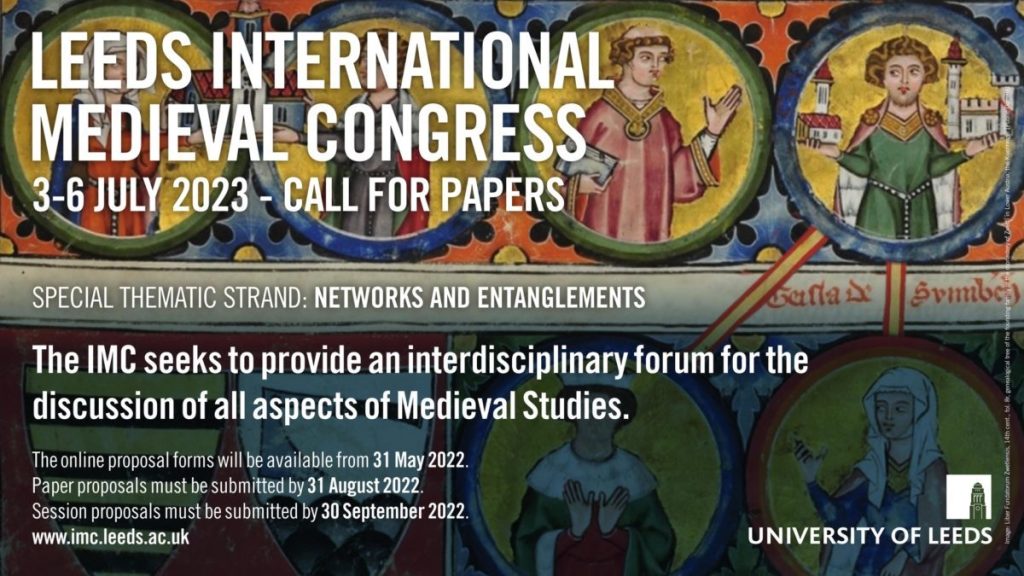
Paper abstracts are currently being sought for the following Tolkien sessions for the International Medieval Congress at Leeds, 1-4 July 2024.  The special thematic strand of this conference will be ‘Crisis’.  See more here 


We are very pleased that the 2024 IMC Tolkien Sessions will again be sponsored by The Centre for Fantasy and the Fantastic at the University of Glasgow - 


Paper submissions are being sought for the following sessions:  


Tolkien’s Medieval Sub-creation in Crisis 


This session will examine different concepts of crisis in Tolkien studies. Papers may explore the types of crises Tolkien himself created in the body of his legendarium by his revising of several keys stories and legends at different times in his lifelong work.  Papers can address the significance of these narratives and their revisions in Tolkien’s shifting ideas about the world and cultures he was inventing. Papers may also explore adaptations of Tolkien works and how they create crises in our evolving understanding of the canon of Tolkien’s work and its reception.  


Bodily Crises in Tolkien’s Medievalism 


Papers in this session can explore crises/concerns of gender and bodily difference in Tolkien’s works including sexuality and disability.  Indicative areas to be examined include the role of bodies under physical duress, punishment, injury from battle or war, as well as bodies in transformation including prosthetics, spiritual transformation (good or evil) and how bodies and body transformation from Tolkien’s works are depicted in illustrations and in films and other media.  


Racial Medievalism in Tolkien Studies - A Session Celebrating the Works of Professor Dimitra Fimi Founder of Tolkien at Leeds.    


Papers in this session may respond to, critique and develop key ideas regarding Tolkien’s representations of race that were first explored in Professor Dimitra Fimi’s ground-breaking 2008 book Tolkien, Race and Cultural History: From Fairies to Hobbits, which won the Mythopoeic Scholarship Award for Inklings Studies in 2010. Fimi’s evolving body of work has brought to light neglected aspects of Tolkien’s creativity and world-building, including the centrality of the Elves, the role of linguistic invention, and the relationships between race and material culture in Middle-earth This session invites papers that explore Tolkien’s contexts, racial representations and world-building through engaging with and building upon the approaches Professor Fimi has set out in her academic work.


Tolkien: Medieval Roots and Modern Branches


This continuing Tolkien at Leeds session will accommodate wider topics and new approaches to Tolkien's medievalism, ranging from source studies and theoretical readings to comparative studies of Tolkien’s works and Middle-earth studies.  


Crises in Researching Tolkien: A Round Table 


The Annual Tolkien at Leeds roundtable will explore the current crises facing Tolkien teachers, academics and researchers in Tolkien and Middle-earth studies.  Topics can include the various adaptions of Tolkien’s works that will continue to grow with new media deals, differing thoughts on treatment of Tolkien’s race, culture and sexuality in his works and the desire of scholars to see, analyse and contextualise more of Tolkien’s remaining unpublished papers.   


  • Please submit a paper contribution title and abstract by 31 August 2023 to  Dr. Andrew Higgins (asthiggins@me.com) 
  • Length of abstracts: 150 words (max!)  
  • Papers will be 15-20 minutes long (3 paper sessions will be preferred) 
  • With your abstract, please include name and details of contributor (affiliation, address, and preferred e-mail address)


Tuesday, 14 March 2023

Tolkien Sessions at Leeds IMC 2023


Eglerio! This year The Centre for Fantasy and the Fantastic, School of Critical Studies, University of Glasgow will be sponsoring six Tolkien sessions at The International Medieval Congress at The University of Leeds from 3-6 July 2023.  This continues the tradition started by our founder Dr.  Dimitra Fimi and is my third year organising these sessions.  

We have a great line up of Tolkien scholars and students exploring many aspects of Tolkien and Middle-earth studies including several papers focused on the subject of this year's conference Networks and Entanglements 

The Lord of the Rings: The Rings of Power and Questions of Adaptation and Authenticity: A Round Table Discussion 

Tuesday 4 July 2023: 19.00-20.00 GMT 

The sessions starts with our continuing Tolkien at Leeds roundtable series in which we will explore one of the most significant new adaptations of Tolkien's works, Amazon Prime's five season The Lord of the Rings: The Rings of Power series. Participants will offer short presentations on some element of this series and how it is (or is not) in dialogue with Tolkien's texts and explore what this new adaptation develops or reveals in the expanding body of adaptive works based in some form on Tolkien's world-building. 

Participants will include Brian Egede-Pedersen (Independent Scholar, Nykøbing Falster), Mercury Natis (Independent Scholar, Worthing), and Kate Natishan (University of Virginia).

Tolkien's Work and Academic Networks at the University of Leeds

Wednesday 5 July 2023: 14.15-15.45 GMT 


J. R. R. Tolkien established his academic career at the University of Leeds, joining as a Reader in 1920, aged 28. By the time he left Leeds in 1925 he had established the University as a leader in Old Icelandic language and literature and developed a network of fellow academics and colleagues. Papers in this session will explore the work and networks developed while he was here at the University of Leeds. 

1) The Missing Letters that J.R.R. Tolkien Received from Derek J. Wilson and R.M. Wilson - New Research and Addendum to Further Notes on J.R.R. Tolkien's Photostats of The Equatorie of the Planets (MS Peterhouse 25) - Andoni Cossio, Facultad de Letras, Universidad del País Vasco - Euskal Herriko Unibertsitatea, Vitoria-Gasteiz 

2) 'An industrious little devil': Tolkien's Development of the Elvish Languages at Leeds, 1920-1925 - Dr. Andrew Higgins, Centre for Fantasy & the Fantastic, School of Critical Studies, University of Glasgow 

3) Leeds and the Medieval Foundation of J. R. R. Tolkien's 'Father Christmas' Letters - Dr. Kristine Larsen, Geological Sciences Department, Central Connecticut State University 

New Works, Networks, and Methods in Tolkien and Middle-earth Research

Wednesday 5 July 2023: 16.30-18.00 GMT 


Papers in this session will explore some of the new methods and critical networks of academic research that are being applied to both Tolkien and Middle-earth studies and what they are revealing about the continuing academic dialogue and discourse around Tolkien and his works. 

1) Tolkien Studies and the 'Theological Turn' - Mitchell Kooh, Department of English, University of Notre Dame, Indiana 

2) Queer Time and Space in Tolkien's Middle-earth -Yvette Kisor, School of Humanities & Global Studies, Ramapo College of New Jersey 

3) Reading Tolkien's First Age through the Lens of Michel de Certeau - Cami Agan, Department of Language & Literature, Oklahoma Christian University 

4) Queer Phenomenology, Lesbian Ents, and the Future of Queer Tolkien Studies - Christopher Vaccaro, Department of English, University of Vermont 

J. R. R. Tolkien: Medieval Roots and Modern Branches

Thursday 6 July 2023: 09.00-10.30 GMT 

This session will address wider topics and new approaches to Tolkien's medievalism ranging from source studies and theoretical readings to comparative studies (including Tolkien's legacy).

1) Riddles in the Mark: The Usage of 'Riddle' in Book III of The Lord of the Rings as Micro Level Interlacing - Christian Trenk, Theologische Fakultät, Katholische Universität Eichstätt-Ingolstadt 

2) Dark are the Pathless Ways - Scott Hodgman, Department of Literature & Language, Signum University, New Hampshire 

3) 'This is a serious journey, not a hobbit walking-party': Travel and the Quest Motif in Tolkien's Work - Eva Lippold, Faculty of Arts & Social Sciences, Open University 

4) 'We swears on the precious': Oath-Making and Oath-Keeping in Tolkien - Literary Devices or Spiritual Statements? - Gaëlle Abaléa, Centre d’Etudes Médiévales Anglaises (CEMA), Sorbonne Université, Paris 

Tolkien's Medieval Entanglements

Thursday 6 July 2023: 11.15-12.45 GMT 


Throughout his life and academic work Tolkien explored and grappled with some of the most perplexing and interesting cruxes and entanglements of medieval literature and language. This sessions will explore some of these entanglements and how Tolkien sought potential solutions.

1) The Interlaced Entanglement of 'The King's Touch' - Amy Amendt-Raduege, Department of English, Western Washington University 

2) The Theme of Decay and Fall in Tolkien's Works and its Medieval Entanglements - Andrzej Wicher, Zakład Angielskiego Dramatu, Teatru i Filmu, Uniwersytet Łódzki 

3 Sam the Scop: The Entanglements of Poetry in Beowulf and The Lord of the Rings - Kirsten Ogilby, Institut for Engelsk, Germansk og Romansk, Københavns Universitet 


Tolkien at Leeds Business Meeting - 

Thursday 6 July 2023 - 1pm GMT - 2pm GMT (Esther Simpson 1.01) 

You can also join the meeting via Zoom at 1pm GMT 

Topic: Andrew Higgins' Zoom Meeting

Time: Jul 6, 2023 01:00 PM London


Join Zoom Meeting

https://us02web.zoom.us/j/83745625576?pwd=aU5DVzFUTStZRkt4TjkyZTdUVkpkdz09


Meeting ID: 837 4562 5576

Passcode: 5FhD6X


Disentangling the Second Age of Tolkien's Middle-earth

Thursday 6 July 2023: 14.15-15.45 GMT 


In Tolkien's great masterwork The Lord of the Rings the Second Age of Middle-earth is a time remembered in poetry and the memories of such witnesses to history as Elrond and Galadriel. Papers in this session will explore this pivotal time in Tolkien's Middle-earth and can be in dialogue with the current Amazon Prime The Lord of the Rings: The Rings of Power an adaptation of this period of Tolkien's legendarium as well as the new volume The Fall of Numenor and Other Tales published by HarperCollins in November 2022. 

1) The Tale of Aldarion and Erendis: Not Just a Medieval Love Story - Dr. Sara Brown, Department of Language & Literature, Signum University, New Hampshire 

2 Out of the Great Sea: Of Elendil and Legends Old and New - S. R. Westvik, School of History, University College Dublin / Historisches Institut, Universität Potsdam 

3) Untangling the Second Age Tale of Years - James Tauber, Department of Literature & Language, Signum University, New Hampshire 

4) The Roads to Númenor: Navigating Tolkien's Mythopoeic Network - Clara Colin-Saïdani, Faculté Lettres et Langages, Nantes Université 

Before the conference on Sunday 2nd July The Tolkien Society is hosting a one day conference The Mighty and Frail Númenor which will be live and free at The Hilton, Leeds and hybrid - more information can be found here - https://www.tolkiensociety.org/2022/10/call-for-papers-tolkien-society-seminar-2023-the-mighty-and-frail-numenor/

As always SODOM fellowship and meading throughout! 


Sunday, 1 December 2019

Eglerio! Tolkien at Leeds IMC 2020 Sessions Announced

What a great opportunity for Dr. Wotan to resume his errant blogging with this announcement about the Tolkien at Leeds International Medieval Congress 2020 which I am co-organising this year with Dr. Dimitra Fimi.  Dr. Fimi has spent the last five years working valiantly and tirelessly to first establish and then organise these sessions at Leeds (you can read Dr. Fimi's roundup reports of the past conferences here: 2015, 2016, 2017, 2018 and 2019 ). 

For the 2020 conference Dr. Fimi and I are organising the conference together so I can 'learn the ropes' to take over organising the conference in 2021 (big shoes to fill!).   For Tolkien at Leeds IMC 2020 Dr. Fimi and I are very pleased to announce that all 5 sessions on J.R.R. Tolkien that were proposed have been accepted: including three that will focus on the overall theme of this year's conference: borders.     

Here are the sessions titles and papers now with the scheduled dates and times.  

SESSION 104: 


J.R.R. Tolkien: Medieval Roots and Modern Branches 


Sponsor: School of Critical Studies, University of Glasgow
Organiser: Dr. Andrew Higgins, Independent Scholar
Moderator/Chair: Deirdre Dawson, Independent Scholar
Session Day/Time: Monday 6 July (11:15-12:45)  

A Preliminary History of Deadly Splinters
Victoria Holtz-Wodzak,  Viterbo University Wisconsin

Tolkien Alliterative Style in The Homecoming of Beorhtnoth Beorhthelm's Son 
Anna Smol, Mount Saint Vincent University, Nova Scotia

Dewdrop, Apple and Pomegranate: Three Symbols of the Ring Bearing in Czerniawski's Wyprawa
Joel Merriner, University of Plymouth UK

Foraging for Sources: Sir Orfeo as the Origin of Medieval Romance Topoi Present in Mirkwood
Andoni Cossio, Universidad del Pais Vasco

Session 905: 


New Sources and Approaches to Tolkien's Medievalism - A Round Table Discussion


Sponsor: School of Critical Studies, University of Glasgow
Organiser and Moderator: Dr. Andrew Higgins, Independent Scholar
Session Day/Time: Tuesday 7 July (19:00-20:00)   

Participants:

Leo Carruthers, Centre d'Etudes Medievales Anglaises (CEMA), Sorbonne Université

Dr. Dimitra Fimi, School of Critical Studies, University of Glasgow

Kristine Larsen, Geological Sciences Department, Central Connecticut State University

Thijs Porck, Centre for the Arts in Society (LUCAS), Universiteit Leiden

This roundtable discussion will focus on works by J.R.R. Tolkien published during the last few years, with a particular emphasis on the latest posthumous publication of Tolkien's Lost Chaucer, edited by John M Bowers (Oxford University Press).


SESSION 1536: 


Borders in Tolkien's Medievalism I     


Sponsor: School of Critical Studies, University of Glasgow 

Organiser: Dr. Andrew Higgins, Independent Scholar 
Moderator/Chair: Kristine Larsen, Central Connecticut State University 
Session Day/Time: Thursday 9 July (9:00-10:30)  

The Liminality of Tolkien's Non-Human Species 

Dr. Andrzej Wicher, Uniwersytet Lodz 

Undead of Undying: Limits of Immortality in Tolkien's Work 

Gaëlle Abaléa, Sorbonne Université Paris 

Implementing the Liminal Space: Vampires and Werewolves  

Sara Brown, Independent Scholar 

Warrior Maidens, Mounds and Ancestral Swords in LOTR and in the Old Norse Hervarar Saga Jan A. Kozák, University of Bergen, Norway


SESSION 1636: 


Borders in Tolkien's Medievalism II 


Sponsor: School of Critical Studies, University of Glasgow 
Organiser: Dr. Andrew Higgins, Independent Scholar 
Moderator/Chair: Sara Brown, Independent Scholar  
Session Day/Time:  Thursday 9 July (11:15-12:45)  

Tolkien's Taliska: Language Invention on Linguistic Borders
Dr. Andrew Higgins, Independent Scholar

Linguistic Borders, Boundaries and Bridges in Tolkien's Writing
Deirdre Dawson, Independent Scholar

Borders of Mind and Nation in Tolkien's Works
Ellen Duncan, Independent Scholar

SESSION 1736: 


Borders in Tolkien's Medievalism III


Sponsor: School of Critical Studies, University of Glasgow  
Organiser and Moderator/Chair: Dr. Andrew Higgins, Independent Scholar
Session Day/Time: Thursday 9 July (14:15-15:45)  

Boundaries and Marches: Marked and Unmarked Edges in Tolkien's Maps
Erik Mueller-Harder, Independent Scholar

The Walls of the World and The Voyage of the Evening Star: The Complex Borders of Medieval Geocentric Cosmology
Kristine Larsen, Central Connecticut State University

The Limits of Subcreation
Lars Konzack, Institute for Kommunikation, Copenhagen Universitet

Time-Travel, Astronomy and Magic Mirrors: The Borders between 'Reality' and 'Otherworlds' within Middle-earth
Aurelie Bremont, Sorbonne Université Paris


Sunday, 24 March 2013

A Philological Journey Down Lake Windermere

Lake Windermere - England's Largest Lake - What Secrets Does It Hold?
David and I just returned from a very restful week holiday up in the Lake District on the southern shores of Lake Windermere.   Lake Windermere is the largest natural lake in England in the county of Cumbria within The Lake District National Park.  On the days when the weather was fairly decent we boarded a boat and went down the lake passing by where Arthur Ransome's adventures of the Walker children in Swallows and Amazons took place (and according to the tour guide on the boat a new version of the adventure is to be filmed there this summer). 

But as we sailed down this majestic lake I could not but help thinking about the name 'Windermere' and what it means.  Perhaps this is one of the very beneficial (among many) effects that intense study of the works of J.R.R. Tolkien has done for me.  For Tolkien a story started with a name ('To me a name comes first and a story follows.' - Letters, p. 219) His imaginative language work has heightened my awareness of names and the inherent stories each proper name carries within it - a potential micro-narrative waiting for its story to be unearthed.  So on my first night back at the hotel I started thinking about what Windermere meant and to do some linguistic sleuthing Tolkien style - and along the way encountered several interesting connections to Tolkien himself! 

I found two key sources online to start my search.  First is a book  Walter John Sedgefield's 'The Place Names of Cumberland and Westmorland' from 1915 which is available on line.  In this work Sedgefield states -

The first element according to Wyld L. Pl. s. p. 266 appears to be a pers N. with the Old Norse genitive ending with -ar Wyld notes that though O.N. *Vigandr does not seem to be recorded, in exact OE Equivalent Wignoth occurs several times (Searle).  The second element is O.E. mere 'lake' 'pool' 'sheet of water'

H.C. Kennedy Wyld's Universal Dictionary of the English Language

The first reference Sedgefield is making is to the 1911 'The Place-Names of Lancashire' by Henry Cecil Kennedy Wyld (1870-1945).   From 1904 to 1920, Wyld was Baines Professor of English Language and Philology, Liverpool University. From 1920 to his death in 1945 he was Professor of English Language and Literature at Oxford and seems to have been one of J.R.R. Tolkien's great allies in the bringing together of the literature and language curriculum at Oxford. According to Hammond and Scull's Chronology - Tolkien knew Wyld and on 20 May 1929 (while at Pembroke College)  Wyld, Tolkien and C.T. Onions signed a letter to the Secretary of Facilities asking the University to appoint a lecturer in 'English Language' (Chronology, p.149).  Tolkien also mentions him in a letter to Christopher when he learns that Wyld has died 'god rest his soul' and he needs to work on finding a replacement for him as Professor of English Language and Literature at Oxford (Letters, p.108).   

The second reference is to W.G. Searle (1830-1913) who was a Professor at Queen's College.  The listing is in Onomasticon Anglo-Saxonicum: A List of Anglo-Saxon Proper Names from the Time of Beda to that of King John (Cambridge, 1897). 

These earlier works are referenced by the Swedish philologist Eilert Ekwall (1877-1964) who wrote many books on the history of language but is probably best known for his work on English Place names and personal names.  Tolkien definitely read and was inspired by Ekwall's works on place names (a topic that I am currently in the process of researching). When Tolkien was a Reader at Leeds University he reviewed several of Ekwall's key works in the journals - The Years Work in English Studies 1923-1925. 

In his 1922 'The Place Names of Lancashire' Ekwall gives a 2 page focus to the name Windermere and brings in the earlier works noted above.  This, so far, is the fullest philological treatment I can find on the meaning of the name 'Windermere.'

Ekwall first suggests that the name Windermere must be identical with that of the name of a place near Great Asby in Wilmington called Winderwath [near Penrith in Cumbria]. 


But Ekwall quickly dismisses this idea due to the fact that both place names are far apart and must have been named independently of each other.  'This shows' says Ekwall 'that Windermere can not have as its first element an old name of the lake as might be supposed

Then Ekwall suggests that Winder is a personal name as has been supported by Wyld and others (as above).  Ekwall supports this theory by saying that it is all the more probable as personal names are the first element of the names Thurston Water and Ullswater in Cumbria.  


The Germanic God Ullr

The two examples Ekwall gives are interesting because both of them are examples of the English countryside having imprinted on them the names of past lost gods of England. One of the best studies of this is Brian Branston's The Lost Gods of England (Thames and London, 1957) which shows how they key Germanic gods worshiped by pre-Christain Anglo-Saxon inhabitants of England can be found in the name of English places.  

After Lake Windermere, Ullswater is the second largest lake in The Lake District.  The first part of its name, according to website for the Lake, may come from the  Germanic God Ullr as their is also evidence of the remains of a viking settlement nearby cammed Hodgson Hill.  Ullr is very interesting - he seems to have been a great Germanic god who diminished and was replaced by Thor (becoming Thor's step-son in some of the Edda accounts).  His name may be connected to the concept of glory.  If indeed this is the meaning of Ullswater as the second lake it must go way back to the first arrival of the Anglo-Saxons from the North where the legend of Ullr may still have been dominant. 

Thurston's Water is the third largest lake and is better known now as Coniston Water - the name 'Thurston' is derived from the Norse god Thor. (Thunor)  As Branston indicates Thor (or Thunor) - along with Woden, Tiw and Frig - was one of the main gods that Anglo-Saxon used to name places in England with (Thanet, Thundridge, Thunderfield)

But then Ekwall takes exception with Sedgefield and suggests another linguistic route - the  name Vinandus which he suggests is a name from the Low German or Old Swedish.  Ekwall suggests that this name may stem from the Old Norse vondr 'staff'. The vondr connection is interesting given a page found at the back of Cleasby/Vigfusson's Old Norse dictionary called 'A List of British Rivers'
which list the roots for a series of rivers in Scotland and North England which are also found (and possibly have their origins) in Edda literature. 

About a hundred in number, contained in old Icelandic alliterative memorial verses (inscribed á-heiti, i. e. names of rivers) from MSS. of the Snorra-Edda (ii. 479, 480, of the 13th century; the verses themselves may well be of the 12th century). Most of these rivers seem to belong to the northern Scottish counties, Caithness, Ross, Moray, Sutherland, and to the north-east of England.

Included in this list is - 'Vind (Vönd, Gm.)' 

The ON word 'Vönd' is found as the name of a river in the Poetic Edda in The Grimnismal (The Says of Grimnir) which describes a series of rivers that issue from Hvergelmir - the bubbling boiling spring or well in Nifelheim from which all cold rivers sprang.  

28. Vino is one, | Vegsvin another,
And Thjothnuma a third;
Nyt and Not, | Non and Hron,
Slith and Hrith, | Sylg and Ylg,
Vith and Von, | Vond and Strond,
Gjol and Leipt, | that go among men,
And hence they fall to Hel.

According to a commentary on this passage in Grimnismal there is a suggestion 'that the name is most likely a nominalization of the feminine singular of the ON adjective vandr 'difficult.' Cf., for example, the Norwegian river Meina  probably derived from the ON verb meina 'to harm, hinder.' Another possibility is that it is related to ON vöndr m. 'wand, switch.' Cf., for example, the river names with the stem gand  the district name Gand and the lake called Gjende (Indrebe, 1924, p. 71), all related perhaps to Norwegian dialect gand m. 'thin stick,' as well as the river names with the stem stav-to ON stafr 'stick, stave' and probably referring to rivers which flow in a straight course for a considerable stretch. A similar meaning may be possible here  And certainly have gone down Lake Windermere several times in the last week I can assure you it follows a fairly straight course for ten miles

This commentary comes from a very interesting site that has many of the early versions of the Eddas and other materials from Norse mythology - quite a treasure trove. 

And this idea also suggests another link to Tolkien - if vondr is related to gandr in terms of  a wand or switch this possibly means that the WINDER- is related to the same world that forms the name of our good friend the Istari Gandalf - coming from the Old Norse (and right from the Dvergatal list in the Eddas -  Gand-alfr - wand or magic staff elf.  But there is more work to be done here as according to Cleasby/Vigfusson the exact meaning of Gandr and Vondr is quite vexed (ah a linguistic crux for further exploration!).  Towards this research there is an interesting passage in a book by John McKinnell Meeting the Other in Norse Myth and Legend
in which he explores the concepts of gandr and possible linguistic connection to vond (although I am still not entirely convinced by the linguistic movement from ge-vond/gand - more work to be done here). 

 Ekwall concludes his study of Windermere by stating that the Winander- part represents the genitive singular of an Old Scandinavian name Vinundr the genitive form Vinandar.  The Mere of Vinandar

So if Vin = vond could in some sense mean either stick (describing the straightness of the lake) or magic there is also a suggestion that the second element UNDR also has a fantastical sense.  Undr is the Norse world for 'wonder' and forms the verb 'undra' to wonder at, be amazed - an 'undra-sjonir' was a wonder to see a spectacle.  http://lexicon.ff.cuni.cz/html/oi_cleasbyvigfusson/b0654.html

So clearly there is a sense that this lake the largest in the area would have been significant to the inhabitants of the area.  I find it interesting that the other two largest lakes, as we have seen above, are both names that have within them echoes of the Lost Gods of England (Ullr and Thor) and it seems odd that Windermere would not as well.  Perhaps the Undra part of the name is pointing to some element  of wonder or amazement that may have its origins in a lost god of the area.  

As I was doing this preliminary investigation into the meaning of Lake Windermere and the mysteries that the understanding of the name might disclose - I thought about what it must have been like on 24 September 1914 when the young J.R.R. Tolkien while staying at his Aunt Jane Neave's farm in Phoenix Farm in Gedling near Nottingham discovered the name Earendel and from his linguistic exploration - his 'finding out' what the name and the story behind it was - gave birth to an entire new mythology. 

As a great teacher (master in the Latin magister sense) who I very much respect and admire recently said to me 'Words can lead you into uncharted territory - both literally and figuratively Sleuth on!'  

A crux for exploration begins - all from England's largest river! 


Sunday, 18 March 2012

Tolkien and Dark Shadows Musings

Greetings from Wotan! Wotan has not sent Hugin and Muin out lately as he has been locked in his fortress of Valhalla researching and studying.

Wotan is very excited to have officially started a Phd research project around the Early Literary and Linguistic Works of J.R.R. Tolkien (1908-early 1920's) and is even triply excited to be working with one of the leading Tolkien visionaries and academics - Dr Dimitra Fimi - through Cardiff Metropolitan University. Wotan is working towards the final research proposal which is due in April and then a full 3-6 years of glorious Tolkienian research (and lots of talk and trying out at ideas at this summer's Return of the Ring Tolkien conference)

Wotan is also in the middle of an excellent online class through Signum University/Mythgard University on J.R.R. Tolkien and C.S. Lewis taught by the excellent Tolkien Professor himself, Professor Corey Olsen's (whose upcoming Exploring the Hobbit book is a must pre-order!). This is a brilliant class where we have compared and contrasted the works of Lewis and Tolkien and we have some exciting upcoming classes including a look at Leaf by Niggle,Athrabeth Finrod ah Andreth, Till We Have Faces, The Notion Club papers, The Voyage of the Dawn Treader and Smith of Wooten Major. There is great work afoot at Signum University/Mythgard Institute and the upcoming summer classes include one on beginners Latin and, be still my heart, Dr Verlyn Flieger teaching a course on Arthurian Literature (which yours truly will probably be virtually attending tuxedo-clad after many excellent evenings at Glyndebourne where Wotan toils.

Also on the Dr. Verlyn Flieger front - joy and exultation her new book Green Sun and Faerie is now available and I have been devouring every chapter which includes some excellent new writing by Dr. Flieger on Tolkien and the Kalevala based on the work she has done on Tolkien's early Kullervo story and Tolkien's 1914-15 talk on The Kalevala.

It is brilliant to have this volume on Tolkien by Dr. Flieger and it stands next to Tom Shippey's Roots and Branches - now one hopes Dr Michael Drout would write a similar volume. A must read

Switching gears - the other excitement for Wotan has been the coming of the new Dark Shadows film in May. But even before this and perhaps even more exciting for Wotan has been the publishing of a new book on Dark Shadows -

The Return to Collinwood by Kathryn Leigh Scott (who played Maggie Evans and Josette Du Pres (among others) in the original Dark Shadows TV show - appearing in over 600 of the 1,222 episodes) and Jim Pearson. I highly recommend this book to any lover of Dark Shadows. There are some great insights into the coming movies and the recollections of Kathryn Leigh Scott and Lara Parker (Angelique) are brilliant and add some interesting info to how this 1,225 episode fantasy/sci-fi/gothic soap opera was flamed as well as the two movies (and I eagerly awaiting the reedited cut of Night of Dark Shadows with the cut scenes put back). good chapters on the revival series as well and he current audio dramas through Big Finish Productions.

Having the book signed by Kathryn Leigh Scott herself makes it one of my treasured Dark Shadow possessions which will never leave me for all eternity and I decided to join the signed picture she sent me with another of my treasured Dark Shadows items which will be familiar to all fans of the show!

Finally there is the upcoming big budget blockbuster Dark Shadows movie starting Johnny Depp as Barnabas and Helena Bonham Carter as Dr. Julia Hoffman directed by Timothy Burton. Wotan is hopeful about this film - the trailer is exciting and yes I think there it is a bit of tongue in cheek treatment of the story (set in the hippie lava lamp strewn days of 1972), But Depp is a great fan of Dark Shadows so I am sure it has been done with care - and it will be fun to watch for the original Dark Shadows cast members (including the first and best Barnabas of all times Jonathan Frid) in the Dark Shadows town ball party scene). Trailer below!


So that is it from Wotan for now - Wotan returns to the Halls of Asgard to consult my friend Erda the green headed torso on the early lexicons of Tolkien - but he will stay in touch and send Hugin and Munin out for news of the many worlds!

Lebe wohl for now!

Sunday, 4 December 2011

Tolkien Work Current and Future and Some Linguistic Archaeology


This week Wotan is taking a break from Nysianer Chronicles (which is taking up many notebooks with root words and proposed declensions and the dreaded chapter two exposition story around the languages more to come in the holiday break)
I wanted to report on some interesting areas of Tolkien Studies Wotan is currently involved with and end with two bonus Tolkienian linguistic explorations that have come out of this work

MYTHGARD INSTITUTE - TOLKIEN AND THE EPIC

I can hardly believe that we are in the final weeks of the Mythgard Institute's very first excellent course Tolkien and the Epic - and what a way to conclude this exploration that has taken us through some of the great works that influenced Tolkien (Beowulf, The Kalevala, The Lay of the Volsungs) and great works by Tolkien himself (Sigurd und Gudrun, The Children of Hurin and The Lay of Leithian).
In addition to excellent lectures by the President of the Mythgard Institute, the Tolkien Professor himself, Corey Olsen (his lectures on The Lay of Leithian were awe inspiring) we have also the incredible good fortune to have guest lectures by some of the pantheon of Tolkienian scholarship including Dr Verlyn Flieger, Tom Shippey (the Gandalf of Tolkien studies) and this week Dr Michael Drout - I consider myself a groupie of all four! It is quite amazing to sit at your computer (our modern day Palantir) and have these important scholars comes as if out of the west to talk about Tolkien and, more importantly, interact with students online with q
uestions and discussions,

And what a way to end this first course than with a three week exploration of Tolkien's masterwork The Lord of the Rings. Dr Drout's talk on The Fellowship of the Ring focused on how Tolkien gets us to care about Middle Earth and how knowledge is distributed in the narrative. This was some of the most original thought I have heard on The Lord of the Rings in a while. I am a massive fan of Dr Drout having heard all his Modern Scholar series and his excellent Anglo-Saxon Aloud podcasts. I have been through his landmark work J. R. R. Tolkien, Beowulf and the Critics twice and am looking forward to his upcoming Tolkien book The Tower and the Ruin and his new book on philology. C.S.Lewis said of Tolkien that he lived inside languages- and I think it can be said of Dr Drout that he lives inside Tolkien - the power of The Mythgard I
nstitute is being able to take a virtual class with an important Tolkien academic like Professor Drout as he sits in his house (having just read a chapter of The Two Towers to his son for bedtime)

The spring the great work of The Mythgard Institute continues with two brilliant courses - Tolkien and Lewis and the Making of Myth and Taking Harry Seriously -Exploring Harry Potter (taught by the excellent Amy Sturgis)

Here is a short film showing some exciting highlights of The Tolkien and Epic Course....

THE GREAT WORK BEGINS
Wotan is also very excited to announce that he has recently been excepted into a Phd Programme through The University of Wales to work with one of the top Tolkien scholars Dr Dimitra Fimi on Tolkien Studies. Dr Fimi is the author of one of the key works on Tolkien - the 2011 Mythopoeic Scholarship Award winning Tolkien, Race and Cultural History: From Fairies to Hobbits.as well as teacher of two of the best online courses I have taken J.R.R Tolkien Myth and Middle Earth in Context and Fantasy Literature Before and After Tolkien

Wotan feels like Frodo at the Council of Elrond starting on this quest! My Phd project which I have started work on is called "I'll have to find out what that means" Employing Literary and Linguistic Archaeology to Unearth the Earliest Strata of Tolkien’s Secondary World - And there will be more to come on this project in the coming weeks, months, and years!

FINDEGIL - An Unsung Gondorian Scribe with Nice Hair

In preparing for our Mythgard Institute The Fellowship of the Ring exploration I re-read the notes on The Shire Records and one character jumped out at me who is very important as without him we would not have the Account of the War of the Ring translated by Professor Tolkien - and that is the Gondorian scribe - FINDEGIL

In the Note on The Shire Records it states that the original Red Book of Westmarch was not preserved. Several copies, with various notes and later additions, were made. The first copy was made by request of King Elessar of Gondor and Arnor, brought to Gondor by Frodo's companion Thain Peregrin I. This copy was known as the Thain's Book and "contained much that was later omitted or lost". In Gondor it underwent much annotation and correction, particularly regarding Elvish languages. Also added was an abbreviated version of The Tale of Aragorn and Arwen by Faramir's grandson Barahir. A copy of a revised and expanded Thain's Book was made probably by request of Peregrin's great-grandson and delivered to the Shire. It was written by the scribe Findegil and stored at the Took residence in Great Smials. This copy was important because it alone contained the whole of Bilbo's Translations from the Elvish (i.e. the great tales of the Silmarillion). It was this version that passed through many hands and came down to Professor Tolkien who translated it.

So without the scribe Findegil we would not have the account of The War of the Ring and perhaps the great tales of the First (and Second?) ages.

So who was Findegil and, more importantly, what does his name mean (key to Tolkien). ]

According to the Encylcopedia of Arda -

" Findegil's main claim to historical notice was due to a note he added to the Thain's Book, marking its completion in the year IV 172. This gives Findegil the distinction of being the last character in any of Tolkien's tales whom we can date with confidence."
So we know he was a scribe who lived in Gondor in the time of the Reunited Kingdom

His name certainly sounds Elvish and specfically Sindarin -

The Roots FIN, FINN, FINDEL all have to do with hair, a single strand or mass PHIN+DELAD hair (as in Glorfindal) GLORFINDEL = GLAUR + PHIN+DELA. DEL thick dense, Q PHINDELE mass of long hair OLD SINDARIN findel later finnel (Parma Eldalamberon 17, p. 17)

But there is also the Quenya gloss FINTA to make, show off or decorate a thing with delicate work (a good root word for a scribe)

GIL of course means star (Gil-Galad) and can also mean glint or spark

Ah but then in The Etymologies we find the root TEK (p. 391) which means to make a mark, write or draw together and the Quenya word TEKIL meaning pen which in Noldorian becomes TEGOL so not to far from DEGIL - so perhaps his name means - He with the fine hair who writes with a pen."

So lets hear if for our fair haired Gondorian scribe Findegil for without his effort we would never have heard of any of these glorious tales!

MUSINGS ON FARAMIR'S NAME

Faramir is one of my favorite characters in The Lord of the Rings and I am enjoying revisiting with him this weekend in preparing the readings for The Two Towers lectures next week by Professor Olsen. I have always thought it interesting that Tolkien gave his own recurring nightmare of the great wave comimg over the land to Faramir.

As to the roots and meaning of his name - there is an easy part and a not so easy part.

The easy part is MIR which according to The Etymologies is the root for jewel, precious thing, treasure from which we get the Quenya MIRE which in Parma Eldalamberon 17 Tolkien quotes for atamir, heirloom as a gloss for the Old English word maðm (a precious treasure, valuable gift) there is also the Quenya word MIRYA for a beautiful work of art. MIRIAMA very precious So it is pretty clear that the MIR ending means jewel of precious thing.

The Fara (or Phara) is s bit trickier. In The Etymologies there is a root PHAR from which we get the Quenya word FARYA meaning suffice, sufficient

So Faramir could be a Quenya/Sindarin mixed name for "a sufficient jewel??"

Boromir's name according to the Etymologies might mean enduring, faithful, loyal -so perhaps his name means faithful or loyal jewel.

It is interesting to posit if Denethor their father gave these names then we are already seeing a bit of the source of favoritism between the two sons - both are jewels but one is loyal and faithful and the other one is only sufficient. Also the irony of Boromir's name based on what happens to him is palpable.

But there is another possible root that comes from Parma Eldalamberon 17 (Words, Phases, and Passages in LOTR) is PHERE which means quick, ready, prompt - so could his name made The Jewel that is ready (to fight) ... Possibly.

That's it for now from Wotan - in the next blog post Wotan will discuss two new books on constructed languages he is currently reading The Dictionary of Made Up Languages and From Elvish to Klingon - Exploring Constructed Languages

Lebe Wohl for now!


Blog Archive