Showing posts with label J.R.R. Tolkien. Show all posts

Thursday, 11 July 2024

CFP for Tolkien at Leeds International Medieval Congress (7-10 July 2025)


In 2025 Tolkien at IMC Leeds (7-10 July 2025) will be celebrating our ten year anniversary having been started in 2015 by our founder Professor Dimitra Fimi.   


We are very pleased that the 2025 IMC Tolkien Sessions will again be sponsored by the Centre for Fantasy and the Fantastic at the University of Glasgow  

Paper submissions are being sought for the following 2025 Tolkien at Leeds sessions:  

Tolkien: Medieval Roots and Modern Branches

This session can accommodate wider topics and new approaches to Tolkien's medievalism, ranging from source studies and theoretical readings to comparative studies of Tolkien’s works.  

Learning, Lore and Craft in Tolkien’s Medieval World 

Papers in this session can explore the role that learning, preserving lore and producing crafts in their widest sense play in Tolkien’s world-building of his Middle-earth legendarium and other fictional and academic works.   

Oral Tradition and Medieval Transmission in Tolkien’s Works 

“From ‘The Book of Lost Tales’ to ‘The Red Book of Westmarch’ and ‘The Notion Club Papers,’ Tolkien crafted various narrative frameworks to convey the conceit of transmitting his invented secondary world into our primary reality. In this session, papers can delve into the significance of orality in Tolkien’s works and explore the diverse transmission frameworks he developed. Additionally, researchers may investigate the literary works that might have influenced Tolkien’s efforts to create these connections 

J.R.R. Tolkien as Teacher and Mentor at Leeds and Beyond 

In this session, papers will celebrate Tolkien’s pivotal role as a teacher and mentor to students at the Universities of Leeds and Oxford. Topics may encompass how Tolkien’s teaching and mentorship influenced scholars, the academic work he supervised, and the establishment of academic clubs like The Viking Club at Leeds and its counterpart, Kolbitar, at Oxford. Additionally, attendees can explore students’ memories of Tolkien as both a teacher and mentor

Tolkien at Leeds Annual Roundtable: Teaching Tolkien 

The Annual Tolkien at Leeds Roundtable will invite educators to discuss and debate teaching methodologies and the unique challenges of bringing Tolkien’s works into 21st-century classrooms.

Please submit a paper contribution title and abstract by 31 August 2024 to  
Dr. Andrew Higgins (asthiggins@me.com) 

  • Length of abstracts: 150 words (max!)  
  • Please include a short bibliography of main research your paper will be drawing on and be in dialogue with.  
  • Papers will be 15-20 minutes long (3 session papers will be preferred) 
  • With your abstract, please include name and details of contributor (affiliation, address, and preferred e-mail address)

Sunday, 3 March 2024

Tolkien Sessions at Leeds IMC 2024


Eglerio! This year The Centre for Fantasy and the Fantastic, School of Critical Studies, University of Glasgow will again be sponsoring six Tolkien sessions at The International Medieval Congress at The University of Leeds from 1st to 4th July .  This continues the tradition started by our founder Professor Dimitra Fimi (whose vision and scholarship we are celebrating this summer!) and is my fourth year organising these sessions.  

We have a great line up of Tolkien scholars and students exploring many aspects of Tolkien and Middle-earth studies including several papers focused on the timely subject of this year's conference CRISIS 

Tolkien Medieval Roots and Modern Branches 

This year we have two sessions which address wider topics and new approaches to Tolkien's medievalism and works.  

Session 1 - Monday 1st July 2024: 11:115-12:45 GMT 

1) "Sir Gawain and the Green Knight" Tolkien's 1953 Lecture and Related Finding: Andoni Cossio, Universidad del País Vasco - Euskal Herriko Unibertsitatea, Vitoria-Gasteiz; University of Glasgow (Virtual) 

2) Gondor Calls for Aid: But Who Will Pay? Brian Egede-Pedersen, Independent Scholar

3) Eärendil's Mythopoeic Journeys - Anna Smol, Mount Saint Vincent University, Nova Scotia

Session 2 - Monday 1st July 2024: 14:15-15:45 GMT 

1) Sub-Creation, Multi-Canon, or Unreliable Narrator: Mythopoeia in Action - Amira Ali Hassan Ali Abdullah, Independent Scholar

2)  'The king has got a crown again': Ruin as Hyperobject in Arda - Will Sherwood, University of Glasgow

3) Freezing the Frame on Crises in the Legendarium through the lens of Alan Lee - Sultana Raza, Independent Scholar

Tolkien's Medieval Sub-Creation in Crisis 

Monday 1st July: 16:30-18:00 GMT 


This session will examine different concepts of crisis in Tolkien studies. 

1) A Medievalist Myth-Making Crisis: Tolkien's Tychonic Cosmology - Kristine Larsen, Central Connecticut State University

2) Bree-folk were sympathetic, but…': Historical Precursors to Middle-Earth's Migration Crisis at the End of the Third Age - Christian Trenk, Katholische Universität Eichstätt-Ingolstadt

3) The Crisis of Arda Marred and How (Not) to Unmar It: The Ring, the Tongue, and the Tower as the New Wheel of Fortune, the New Tower of Babel, and the New World Tree - Cameron Bourquein, Independent Scholar

Racial Medievalism in Tolkien Studies: A Session Celebrating the Works of Professor Dimitra Fimi, Founder of Tolkien at Leeds

Tuesday 2nd July 2024: 11:15-12:45 GMT 


In this session we will celebrate the work and scholarship of our Tolkien at Leeds IMC founder and leading scholar and author of Tolkien and speculative literature Professor Dimitra Fimi whose ground-breaking 2008 book Tolkien, Race and Cultural History: From Fairies to Hobbits, won the Mythopoeic Scholarship Award for Inklings Studies in 2010. Fimi’s evolving body of work has brought to light neglected aspects of Tolkien’s creativity and world-building, including the centrality of the Elves, the role of linguistic invention, and the relationships between race and material culture in Middle-earth 

1) Into the West: Wonders and Woes of Looking for 'Celtic' Inspirations in the Works of J. R. R. Tolkien - Aurelie Bremont, Sorbonne Université, Paris

2) Teaching Song and Holiness: An Exploration of the Mystic and Syncretic Elements of Tolkien's Earliest Elvish Language Invention: Andrew Higgins, Independent Scholar 

Tolkien at Leeds Business Meeting - 1pm-1:45pm GMT - 

To Join via Zoom: 

Join Zoom Meeting

https://us04web.zoom.us/j/74677333558?pwd=5TBbknvYUOOb9sZRplpS4t4xOUTuG0.1


Meeting ID: 746 7733 3558

Passcode: 5m92am

Bodily Crises in Tolkien's Medievalism

There will be two sessions exploring crises/concerns of gender and bodily difference in Tolkien’s works including sexuality and disability.  Indicative areas to be examined include the role of bodies under physical duress, punishment, injury from battle or war, as well as bodies in transformation including prosthetics, spiritual transformation (good or evil) and how bodies and body transformation from Tolkien’s works are depicted in illustrations and in films and other media.


Session 1 - Weds 3rd July: 14:15-15:45 GMT 

1) Altered Bodies, Altered States in the 'Tale of Tinúviel' - Cami Agan, Oklahoma Christian University

2) Éowyn and/or Dernhelm: Tolkien's Paradoxical Gendering of Éowyn's Disguise Gavin Foster, Dalhousie University, Nova Scotia

3) The Torment of Maedhros and a Crisis of Mercy: Bodily Crises in Tolkien's Medievalism - Mercury Natis, Signum University, New Hampshire

Session 2 - Weds 3rd July: 16:30-18:00 GMT 

'Restless and uneasy...thin and stretched': The Ring, the Ringbearers, and Bodies in Psychological Crisis in Tolkien's The Lord of the Rings - Sara Brown, Signum University, New Hampshire

Bodily Transformations in Tolkien's Middle-Earth: The Metamorphosis of Elwing - Yvette Kisor, Ramapo College of New Jersey

'He was naked, lying as if in a swoon': Gazing Queerly at Frodo's Saintly Body in Crisis - Christopher Vaccaro, University of Vermont

Crisis in Researching Tolkien: The Annual Tolkien at Leeds Roundtable 

Weds 3rd July: 19:00-20:00 GMT 


We will end the 2024 Tolkien at Leeds Session with the annual roundtable - this year in response to the conferences overall theme a panel of Tolkien scholars will explore the current crises facing Tolkien teachers, academics, and researchers in Tolkien and Middle-earth studies.    

As always SODOM (The Society for the Drinking of Mead) Events and Fellowship throughout! 

On Saturday 6th July The Tolkien Society will be presenting Tolkien Society Hybrid Seminar 2024 – Tolkien’s Romantic Resonances at the Hilton Leeds City 

See you in Leeds this July! 


Thursday, 20 July 2023

CFP: Leeds 2024 IMC Tolkien Sessions


CFP: Leeds 2024 IMC Tolkien Sessions 


Paper abstracts are currently being sought for the following Tolkien sessions for the International Medieval Congress at Leeds, 1-4 July 2024.  The special thematic strand of this conference will be ‘Crisis’.  See more here 


We are very pleased that the 2024 IMC Tolkien Sessions will again be sponsored by The Centre for Fantasy and the Fantastic at the University of Glasgow


Paper submissions are being sought for the following sessions:  


Tolkien’s Medieval Sub-creation in Crisis 


This session will examine different concepts of crisis in Tolkien studies. Papers may explore the types of crises Tolkien himself created in the body of his legendarium by his revising of several keys stories and legends at different times in his lifelong work.  Papers can address the significance of these narratives and their revisions in Tolkien’s shifting ideas about the world and cultures he was inventing. Papers may also explore adaptations of Tolkien works and how they create crises in our evolving understanding of the canon of Tolkien’s work and its reception.  


Bodily Crises in Tolkien’s Medievalism 


Papers in this session can explore crises/concerns of gender and bodily difference in Tolkien’s works including sexuality and disability.  Indicative areas to be examined include the role of bodies under physical duress, punishment, injury from battle or war, as well as bodies in transformation including prosthetics, spiritual transformation (good or evil) and how bodies and body transformation from Tolkien’s works are depicted in illustrations and in films and other media.  


Racial Medievalism in Tolkien Studies - A Session Celebrating the Works of Professor Dimitra Fimi Founder of Tolkien at Leeds.    


Papers in this session may respond to, critique and develop key ideas regarding Tolkien’s representations of race that were first explored in Professor Dimitra Fimi’s ground-breaking 2008 book Tolkien, Race and Cultural History: From Fairies to Hobbits, which won the Mythopoeic Scholarship Award for Inklings Studies in 2010. Fimi’s evolving body of work has brought to light neglected aspects of Tolkien’s creativity and world-building, including the centrality of the Elves, the role of linguistic invention, and the relationships between race and material culture in Middle-earth This session invites papers that explore Tolkien’s contexts, racial representations and world-building through engaging with and building upon the approaches Professor Fimi has set out in her academic work.


Tolkien: Medieval Roots and Modern Branches


This continuing Tolkien at Leeds session will accommodate wider topics and new approaches to Tolkien's medievalism, ranging from source studies and theoretical readings to comparative studies of Tolkien’s works and Middle-earth studies.  


Crises in Researching Tolkien: A Round Table 


The Annual Tolkien at Leeds roundtable will explore the current crises facing Tolkien teachers, academics and researchers in Tolkien and Middle-earth studies.  Topics can include the various adaptions of Tolkien’s works that will continue to grow with new media deals, differing thoughts on treatment of Tolkien’s race, culture and sexuality in his works and the desire of scholars to see, analyse and contextualise more of Tolkien’s remaining unpublished papers.   


  • Please submit a paper contribution title and abstract by 31 August 2023 to  Dr. Andrew Higgins (asthiggins@me.com
  • Length of abstracts: 150 words (max!)  
  • Papers will be 15-20 minutes long (3 paper sessions will be preferred) 
  • With your abstract, please include name and details of contributor (affiliation, address, and preferred e-mail address)


Tuesday, 14 March 2023

Tolkien Sessions at Leeds IMC 2023


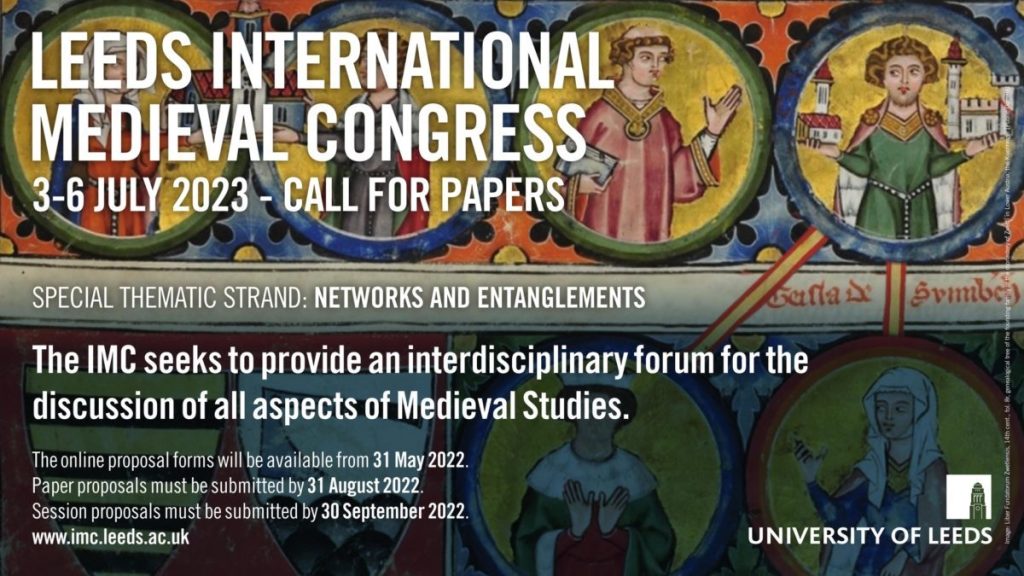
Eglerio! This year The Centre for Fantasy and the Fantastic, School of Critical Studies, University of Glasgow will be sponsoring six Tolkien sessions at The International Medieval Congress at The University of Leeds from 3-6 July 2023.  This continues the tradition started by our founder Dr.  Dimitra Fimi and is my third year organising these sessions.  

We have a great line up of Tolkien scholars and students exploring many aspects of Tolkien and Middle-earth studies including several papers focused on the subject of this year's conference Networks and Entanglements 

The Lord of the Rings: The Rings of Power and Questions of Adaptation and Authenticity: A Round Table Discussion 

Tuesday 4 July 2023: 19.00-20.00 GMT 

The sessions starts with our continuing Tolkien at Leeds roundtable series in which we will explore one of the most significant new adaptations of Tolkien's works, Amazon Prime's five season The Lord of the Rings: The Rings of Power series. Participants will offer short presentations on some element of this series and how it is (or is not) in dialogue with Tolkien's texts and explore what this new adaptation develops or reveals in the expanding body of adaptive works based in some form on Tolkien's world-building. 

Participants will include Brian Egede-Pedersen (Independent Scholar, Nykøbing Falster), Mercury Natis (Independent Scholar, Worthing), and Kate Natishan (University of Virginia).

Tolkien's Work and Academic Networks at the University of Leeds

Wednesday 5 July 2023: 14.15-15.45 GMT 


J. R. R. Tolkien established his academic career at the University of Leeds, joining as a Reader in 1920, aged 28. By the time he left Leeds in 1925 he had established the University as a leader in Old Icelandic language and literature and developed a network of fellow academics and colleagues. Papers in this session will explore the work and networks developed while he was here at the University of Leeds. 

1) The Missing Letters that J.R.R. Tolkien Received from Derek J. Wilson and R.M. Wilson - New Research and Addendum to Further Notes on J.R.R. Tolkien's Photostats of The Equatorie of the Planets (MS Peterhouse 25) - Andoni Cossio, Facultad de Letras, Universidad del País Vasco - Euskal Herriko Unibertsitatea, Vitoria-Gasteiz 

2) 'An industrious little devil': Tolkien's Development of the Elvish Languages at Leeds, 1920-1925 - Dr. Andrew Higgins, Centre for Fantasy & the Fantastic, School of Critical Studies, University of Glasgow 

3) Leeds and the Medieval Foundation of J. R. R. Tolkien's 'Father Christmas' Letters - Dr. Kristine Larsen, Geological Sciences Department, Central Connecticut State University 

New Works, Networks, and Methods in Tolkien and Middle-earth Research

Wednesday 5 July 2023: 16.30-18.00 GMT 


Papers in this session will explore some of the new methods and critical networks of academic research that are being applied to both Tolkien and Middle-earth studies and what they are revealing about the continuing academic dialogue and discourse around Tolkien and his works. 

1) Tolkien Studies and the 'Theological Turn' - Mitchell Kooh, Department of English, University of Notre Dame, Indiana 

2) Queer Time and Space in Tolkien's Middle-earth -Yvette Kisor, School of Humanities & Global Studies, Ramapo College of New Jersey 

3) Reading Tolkien's First Age through the Lens of Michel de Certeau - Cami Agan, Department of Language & Literature, Oklahoma Christian University 

4) Queer Phenomenology, Lesbian Ents, and the Future of Queer Tolkien Studies - Christopher Vaccaro, Department of English, University of Vermont 

J. R. R. Tolkien: Medieval Roots and Modern Branches

Thursday 6 July 2023: 09.00-10.30 GMT 

This session will address wider topics and new approaches to Tolkien's medievalism ranging from source studies and theoretical readings to comparative studies (including Tolkien's legacy).

1) Riddles in the Mark: The Usage of 'Riddle' in Book III of The Lord of the Rings as Micro Level Interlacing - Christian Trenk, Theologische Fakultät, Katholische Universität Eichstätt-Ingolstadt 

2) Dark are the Pathless Ways - Scott Hodgman, Department of Literature & Language, Signum University, New Hampshire 

3) 'This is a serious journey, not a hobbit walking-party': Travel and the Quest Motif in Tolkien's Work - Eva Lippold, Faculty of Arts & Social Sciences, Open University 

4) 'We swears on the precious': Oath-Making and Oath-Keeping in Tolkien - Literary Devices or Spiritual Statements? - Gaëlle Abaléa, Centre d’Etudes Médiévales Anglaises (CEMA), Sorbonne Université, Paris 

Tolkien's Medieval Entanglements

Thursday 6 July 2023: 11.15-12.45 GMT 


Throughout his life and academic work Tolkien explored and grappled with some of the most perplexing and interesting cruxes and entanglements of medieval literature and language. This sessions will explore some of these entanglements and how Tolkien sought potential solutions.

1) The Interlaced Entanglement of 'The King's Touch' - Amy Amendt-Raduege, Department of English, Western Washington University 

2) The Theme of Decay and Fall in Tolkien's Works and its Medieval Entanglements - Andrzej Wicher, Zakład Angielskiego Dramatu, Teatru i Filmu, Uniwersytet Łódzki 

3 Sam the Scop: The Entanglements of Poetry in Beowulf and The Lord of the Rings - Kirsten Ogilby, Institut for Engelsk, Germansk og Romansk, Københavns Universitet 


Tolkien at Leeds Business Meeting

Thursday 6 July 2023 - 1pm GMT - 2pm GMT (Esther Simpson 1.01) 

You can also join the meeting via Zoom at 1pm GMT 

Topic: Andrew Higgins' Zoom Meeting

Time: Jul 6, 2023 01:00 PM London


Join Zoom Meeting

https://us02web.zoom.us/j/83745625576?pwd=aU5DVzFUTStZRkt4TjkyZTdUVkpkdz09


Meeting ID: 837 4562 5576

Passcode: 5FhD6X


Disentangling the Second Age of Tolkien's Middle-earth

Thursday 6 July 2023: 14.15-15.45 GMT 


In Tolkien's great masterwork The Lord of the Rings the Second Age of Middle-earth is a time remembered in poetry and the memories of such witnesses to history as Elrond and Galadriel. Papers in this session will explore this pivotal time in Tolkien's Middle-earth and can be in dialogue with the current Amazon Prime The Lord of the Rings: The Rings of Power an adaptation of this period of Tolkien's legendarium as well as the new volume The Fall of Numenor and Other Tales published by HarperCollins in November 2022. 

1) The Tale of Aldarion and Erendis: Not Just a Medieval Love Story - Dr. Sara Brown, Department of Language & Literature, Signum University, New Hampshire 

2 Out of the Great Sea: Of Elendil and Legends Old and New - S. R. Westvik, School of History, University College Dublin / Historisches Institut, Universität Potsdam 

3) Untangling the Second Age Tale of Years - James Tauber, Department of Literature & Language, Signum University, New Hampshire 

4) The Roads to Númenor: Navigating Tolkien's Mythopoeic Network - Clara Colin-Saïdani, Faculté Lettres et Langages, Nantes Université 

Before the conference on Sunday 2nd July The Tolkien Society is hosting a one day conference The Mighty and Frail Númenor which will be live and free at The Hilton, Leeds and hybrid - more information can be found here - https://www.tolkiensociety.org/2022/10/call-for-papers-tolkien-society-seminar-2023-the-mighty-and-frail-numenor/

As always SODOM fellowship and meading throughout! 


Friday, 20 May 2022

Tolkien Sessions at Leeds IMC 2022 - Full Schedule

 Eglerio!  Here is the full schedule of 2022 Tolkien at Leeds Sessions for this summer's conference.  

Thanks to our founder Dr. Dimitra Fimi the 2022 Tolkien at Leeds sessions are being sponsored by The Center for Fantasy and the Fantastic at the University of Glasgow 

Before the IMC Conference Starts - The Tolkien Society will be hosting a one day seminar on Tolkien and the Gothic on Sunday 3rd July in Leeds - more information here 

Monday 4th July 11:15-12:45 GMT (Session 141) 

J.R.R. Tolkien: Medieval Roots and Modern Branches 

Moderator: Dr. Kristine Larsen,  Central Connecticut State University

'An Attempt to Re-Examine the Dialectic of the East and the West in Tolkien’s Selected Works' - Andrzej Wicher, Uniwersytet Łódzki

"Of Dust Motes, Trees, and Golden Flowers: Tolkien and Duns Scotus’ Haeccitas- Victoria-Holtz Wodzak, Viterbo University, Wisconsin

"Epistolary Glossopoesis: The Role of Early Reader and Author Responses in the Development of the Elvish Languages"  Dr. Andrew Higgins 

Monday 4th July 14:15-15:45 GMT (Session 241) 

Tolkien and Medieval Poets: A Session in Memory of Richard C. West  

Moderator: Dr. Andrew Higgins 

"The Revivalist Critic and the Alliterative Poet: An Unexpected Collaboration" Dr. Andoni Cossio, Universidad del País Vasco 

"Computing the Interlace Structure of The Lord of the Rings" James Tauber  Lancaster University

‘Pearls’ of Pearl: Medieval Appropriations in Tolkien’s Mythology - Dr. Kristine Larsen, Central Connecticut State University

Monday 4 July 19:00-20:00 GMT (Session 441) 

Round Table Discussion: Tolkien As A Gateway to Interdisciplinary Teaching 

Moderator: Dr Andrew Higgins 

This round table discussion will feature talks by teachers on how they have used the works of Tolkien to introduce and engage students with new fields of study and disciplines. Short papers and discussions will explore how teachers have used the works of Tolkien as a gateway for students to explore and become passionate about other areas of study.

Scheduled participants: Deirdre Dawson, Dr. Jane Beal, Gaëlle Abaléa, Brian Egede-Pedersen, Dr. Dimitra Fimi 

Wednesday 6th July 9:00-10:30 GMT (Session 1033) 

Borders Between Life and Death in Tolkien's Legendarium 

Moderator: Dr. Sara Brown 

'Memories on Borders: On the Borders of Memory - Beleriand as Elegiac Landscape" Cami Agan Department of Language & Literature, Oklahoma Christian University  

"Beyond the Circle of the World" Amy Amendt-Raduege Department of English, Western Washington University

Undead or Undying: Limited of Immortality in Tolkien's Work'  Gaëlle Abaléa, Independent Scholar, Orléans

Wednesday 6th July 11:15-12:45 GMT (Session 1131) 

Family, Orientation, Transgression and Crossing Borders of Middle-earth 

Moderator: Dr. Andrew Higgins 

'Tolkien’s Orphaned Heroes' - Deidre Dawson, Residential College in the Arts & Humanities, Michigan State University

'Chrononormativity and Queer Time: Crossing Temporal Borders in Tolkien’s Middle-Earth' Yvette Kisor, Humanities & Global Studies, Ramapo College of New Jersey

‘Finding out what lies beyond the borders of the Shire’: Applying Tolkien’s Fantastic Texts in and to Madness - The Transgressive Experience of Psychotic Thinking' Alke Haarsma-Wisselink, Independent Scholar, Zwolle

‘Lay your head in my lap’: Homoerotic Tension and Possibility on Mordor’s Border in The Lord of the Rings' Olivia-Kate Burgham, Independent Scholar, Ottawa

Thursday 7 July 2022 11:15-12:45 (GMT) Session 1641 

Crossing Borders in Middle-earth 

Moderator: Dr. Andrew Higgins 

"Light: The Key to Cross the Spatiotemporal Borders in J. R. R. Tolkien's Secondary World" Aslı Bülbül Candaş, School of Critical Studies, University of Glasgow 

"Interrogating the Liminal Space: Vampires and Werewolves in Middle-earth"  Dr. Sara Brown, Signum University 

"Time Travel, Astronomy, and Magic Mirrors: How the Borders between Reality and the Otherworld in Middle- Earth Are Influenced by Celtic Mythology and Science (Fiction)' Aurelie Bremont, Centre d’Etudes Médiévales Anglaises (CEMA), Sorbonne Université, Paris

Tolkien at Leeds IMC 2022 Business Meeting - TBD 

SODOM fellowship and meading throughout!  


Thursday, 15 July 2021

LIVE Tolkien Sessions at Leeds 2022 - Feb 2022 Update


Tolkien sessions at Leeds IMC 2022 (4-7 July 2022) 


Eglerio! These sessions have now been announced and there will be a more detailed blog post coming! 


For now you can see the sessions and speakers here just put Tolkien in the Sessions search 


This year thanks to our founder Dr. Dimitra Fimi these sessions will be sponsored by Centre for Fantasy and the Fantastic at University of Glasgow


See you in Leeds! 


Saturday, 20 February 2021

Eglerio! Tolkien Sessions at Leeds IMC 2021

Greetings all!  I hope all are doing well during these mad times.  In the darkest hours of lockdown and uncertainty I have kept in mind and heart that great Elvish war cry of Hurin during the Fifth Battle of Beleriand - Aurë Entuluva - Day Shall Come Again!   

As sadly has become the trend this year the Leeds International Medieval Congress will be held on line from 5-9 July 2021 and registration for the online conference will open in March 2021.

This is my first year of having the extreme honour to take over the mantle of organising the Tolkien Sessions for this conference from our visionary founder, scholar and writer Dr. Dimitra Fimi whose incredible work has established these Tolkien sessions at Leeds IMC has an integral part of Tolkien scholarship. 

I am so pleased that all the Tolkien Sessions that we submitted earlier this year have been accepted for the on-line conference and below please find the online schedule of Tolkien sessions and presenters.  

J.R.R. Tolkien: Medieval Roots and Modern Branches (Session 1721) 

Thursday 8 July 14:15-15:45 

Moderator: Dr. Andrew Higgins 

Borders on the Otherworld: Warrior Maidens, Mounds, and Ancestral Swords in The Lord of the Rings and in the Old Norse Hervar Saga -  Jan A. Kozak

Flocking to the Serpent Banner - Decolonising The Lord of the Ring's Workshop's Table-Top War Game - Brian Egede-Pedersen 

The Raven and the Map: Decoding Gyözö Vida's A Gyürük Ura (Joel Merriner) 

Tolkien's Alliterative Styles in The Homecoming of Beorhtnoth Beorhthelm's Son (Anna Smol) 

Tolkien and Diversity: A Round Table Discussion - Thursday 8 July (19:00-20:30) (Session 1921) 

Moderator: Professor Yvette Kisor 

Participants: Deidre Dawson, Sultana Raza, Christopher Vaccaro    

Medieval Climates, Cosmologies and EcoSystems in the works of J.R.R. Tolkien (I) - Friday 9 July (14:15-15:45) (Session 2212) 

Moderator: Dr. Sara Brown 

The Importance of Geographical Directions in the construction of Tolkien's Middle-earth (Andrzej Wicher) 

King Elessar in Middle-earth: Strawberry Fields Forever? (Aurelie Bremont) 

'Carry on My Wayward Sonne (and Moon)' Common Cosmological Quirks in the Norse Fimbul-Winter and Tolkien's Early Legendarium (Dr. Kristine Larsen) 

Political Climate in the 'The Fall of Numenor' (Gaëlle Abalea) 

Medieval Climates, Cosmologies and EcoSystems in the works of J.R.R. Tolkien (II) Friday 9 July (16:30-18:00)  (Session 2312) 

The Myth of the Mother - Retracing the Roots of Motherhood in Tolkien's Decaying Middle-earth (Dr. Helen Lawson) 

Situating Middle-earth: Reconsidering Tolkien's Relationship with the Landscape (Dr. Sara Brown) 

Language Invention, Climate and Landscapes in Tolkien's Gnomish Lexicon (Dr. Andrew Higgins) 

How Alan Lee's Landscapes Outline the Climate of Plot and Tolkien's Mind-scapes (Sultana Raza)  

I will arrange the IMC Tolkien Sessions Business Meeting to discuss plans for the 2022 sessions during the week of this conference. 

So looking forward to seeing everyone including the Sacred Fellowship of the Society of Mead Drinkers (aka SODOM) this July in our virtual Leeds conference. 


Saturday, 18 February 2017

2017 A Look Ahead


Greetings to all from Valhalla which in the last four months has moved from London to lovely Brighton by the sea.  Wotan never thought he would live 5 blocks from a full blown pier and amusement park - so whenever Wotan tires of working on the various projects that I will be previewing below he can always go and ride on a roller coaster or take a visit to the Haunted Mansion.   

I have not blogged in a while and want to start again to share some of the work I am currently doing on Tolkien, World-Building and various others projects.  


Well 2017 is shaping up to be quite a busy year for Dr. Wotan after his work on the PhD thesis 'The Genesis of Tolkien's Mythology' and co-editing A Secret Vice: Tolkien on Language Invention with Dr. Dimitra Fimi.  I will be giving four papers this year as follows two across the pond in Kalamazoo, Michigan and two at the Tolkien sessions that the brilliant work of Dr. Fimi has established at The IMC in Leeds.   The abstracts I have written for these papers are below and Wotan is busy researching and writing them now! 

Tolkien Symposium at The Western Michigan University Library - 10 May (1-5pm) 


Mapping Tolkien's The Book of Lost Tales: Exploring 'I Vene Kemen'  (The Ship of the Earth) 

One of the unique para-textual elements that Christopher Tolkien published in the first volume of The Book of Lost Tales which is celebrating its 100th Anniversary in 2017 was a map in the form of a viking ship which his father invented as he was writing the first version of his mythology.   In this paper I will examine this conceptual and radical map called ‘I Vene Kemen’ (‘The Ship of the Earth’) from three perspectives.  First, as a key element of Tolkien’s early myth-making;  examining how it is linked to the body of ‘Lost Tales’ he was composing.  Secondly, as a para-textual artefact which reflects Tolkien use of his emerging Elvish languages.  Here I will focus specifically on how the place names on the map reflect the ‘consistent and coherent’ nomenclature Tolkien invented drawn from the Elvish lexicons and grammars he was developing at the time.  Finally, I will examine this map as a key element in the wider process of ‘world-building’ for fiction.  Here I will explore how this map represents the first of many maps Tolkien would invent and integrate into his narratives to build the world of his legendarium.   I will also explore and suggest some possible reasons why Tolkien decided to cast this map in this conceptual form of a viking ship based on his early objective of linking his unique mythology to a lost tradition of England.  

52nd International Medieval Congress - Tolkien at Kalamazoo 
Tolkien and Language Session - Saturday 13 May 

Elvish Practitioners of the 'Secret Vice 

In the course of his life Tolkien explored his thoughts and feelings on the role of language-invention as an interlinked element of myth-making and world-building in two key manifestos: his 29 November1931 talk 'A Secret Vice' and in his inaugural O’Donnell Memorial lecture of 1955 ‘English and Welsh’. Tolkien not only used his mythology to illustrate to his readers how he felt language invention should work in his Legendarium. In several instances within the context of his secondary world Tolkien both mythologized and embedded into the very narrative and discourse of several key mythic texts examples of peoples practicing the ‘secret vice’ of language invention which followed the theories Tolkien explored in the two key manifestos above. In this paper I will critically analyze several texts that Tolkien wrote in the 1950's and 60's (especially the ‘Dangweth Pengoloð' - 'The Answer of Pengoloth') to explore how Tolkien embedded his theories of language and language invention into these texts and also analyse why Tolkien especially had his first-born Elves practice the craft of language invention 'an art for which life is not long enough' (SV, p. 11).  


Poetry and Language Invention: The Interconnected Nature of Tolkien’s ‘The Qenya Lexicon’ and His Early World-Building Poetry.
In the Spring of 1915 Tolkien started the invention of his earliest Elvish language, Qenya, by composing two key documents – ‘The Qenya Lexicon’ and ‘The Qenya Phonology’Concurrent with this Tolkien also built his emerging secondary world mainly through poetic composition.  In this paper I will explore the interrelated nature of Tolkien’s earliest language invention and poetic composition from several perspectives. First I will explore how Tolkien included in ‘The Qenya Lexicon’ invented word forms that were designed to make select Elvish words sound more poetic and musical.  Secondly, I will demonstrate through a lexical analysis of some of the key poems Tolkien composed during this time, including his foundational world-building poem of July 1915 ‘The Shores of Faery’, a high corrospondance between the words in these early poems and the base roots and words Tolkien invented in ‘The Qenya Lexicon’; suggesting Tolkien may have been intending to render some of the English poems into Qenya.   Finally I will explore the lexical and grammatical sources of Tolkien’s first Elvish poem ‘Narqelion’ in Tolkien’s ‘The Qenya Lexicon’ showing the strong bond that existed even in this earliest period of Tolkien’s mythopoeia between poetry and language invention .  


'A Secret Vice', the 1930's and the Growth of Tolkien's 'Tree of Tongues'  

In this paper I will explore how after giving us 1931 talk 'A Secret Vice', and as I will argue in several ways because of it, that Tolkien embarked on a new phase of his Elvish language invention by creating his 'Tree of Tongues' that has its conceptual roots in a proto-Eldarin ur-language and through-out the 1930's branched out into over ten different related Elvish languages existing in varying forms of linguistic development.  I will explore how Tolkien's development of this 'Tree of Tongues' drew conceptually upon his training and experience as both a philologist and medievalist and mythically reimagined the real-world attempt by 19th century philologists to reconstruct a similar type of structure for Indo-European languages suggesting it too had a common origin in a reconstructed 'port-Indo-European' language.  I will also explore how this 'Tree' fulfilled the requirement Tolkien explored in 'A Secret Vice' that art-lancs should have a fictional historical background including a sense of hypothetical change over time.  I will explore how Tolkien's 'Tree' is intertwined and interrelated to such key texts from the 1930's including 'The Quenta' and 'The Quenta Silmarillion', 'The First Silmarillion Map', the Annals of Valinor and Beleriand and the two key works on the Elvish languages Tolkien wrote in this period 'The Lhammas' and 'The Etymologies' 

________________________________________________________________________________

Well that should keep Wotan busy but wait there's more!  I am also very busy working on turning my PhD thesis 'The Genesis of Tolkien's Mythology' into a book and also Wotan is very excited that he will be working on a paper for an upcoming publication delving into the Gothic World-Building of the trans-medial diegetic world of Dark Shadows (more to come on this!).  

Talking about world-building one of Wotan's reading highlights this year, so far, has been a brilliant anthology of papers on world-building edited by Mark J.P. Wolf, Revisiting Imaginary Worlds: A Subcreation Studies Anthology for which I wrote a short review of for Amazon.uk giving it 5 stars (quoted below).  This is a must read book for anyone interested in world-building for fiction or any other media.  

'Professor Mark J.P. Wolf’s 2012 monograph Building Imaginary Worlds: The Theory and History of Subcreation (Routledge) was for me, and many others, a revelatory text as it dealt with how imaginary worlds are created in fiction; focusing on the trans-medial elements, in addition to the core narrative, that go into building secondary-worlds. Now Wolf has followed up his brilliant work on the theory behind world-building by bring together a group of leading scholars to explore various elements of world-building in fictional texts as well as physical and virtual environments. Wolf very helpfully divides these papers up into key sections. In 'Worlds on the Rise' three scholars examine different aspects of world-building. Dr. Dimitra Fimi's brilliant paper 'The Past as an Imaginary World: The Case of Medievalism' cogently explores three different author’s - Thomas Chatterton, J.R.R. Tolkien and Umberto Eco - work on inventing an imagined world aimed at representing a medieval past. Fimi puts in-depth focus on the actual process each of these authors used in inventing their versions of medievalism through their making of actual artefacts (forged and feigned documents) as well as constructing narrative transmission schemes to ground these worlds in a sense of reality. Fimi’s re-contextualisation of what has been considered the forgeries of an author like Thomas Chatterton as actually an inventive act of world-building is sure to open up new vistas of exploration around these and related texts. The section called 'Structure' offers a good set of papers exploring the actual mechanics of secondary worlds; ranging from Tolkien's world-building work to that of the role of religion as a world-building element in the television texts Battlestar Galactica and (the short-lived) Caprica as well as the transformational world-building and user reception of Minecraft. In the ‘Practice’ section there are several papers on specific fictional world-building. For me, the two papers on the American fantasy author Frank L. Baum really stood out here. Michael O Riley suggests one of the key sources of Baum's well-known Oz series of books is actually another work Baum wrote in the same year he wrote his most famous book, The Wonderful Wizard of Oz (1900) called A New Wonderland which was overshadowed by the success of the first Oz book. A New Wonderland is a collection of stories that are set in the magical land of Phunnyland. Riley cogent exploration of this ‘lost’ text demonstrates that Baum would use several key elements of Phunnyland in his later Oz books (which itself grew in the series from being a portal world into a fully immersive secondary world) and also explores how prolific a world-builder Baum was outside of just his more well known Oz series. Henry Jenkins provides a good counter-point to Riley’s paper by exploring how the Baum’s Oz mythos was adapted in the recent film Oz the Great and Powerful (2013) which suggested a backstory to the origin of the Wizard by drawing upon elements of not only Baum’s original work put also key adaptations such as the famous MGM Musical The Wizard of Oz and the more recent stage musical Wicked. The series of papers on 'Reception' show how world-building for fiction can be expanded through what Henry Jenkins has called 'multi-media layering.' A good example is the extension of a fictional world coming from film or television through novelizations. William Proctor and Mathew Freeman's paper examines the very recent debate in the Star Wars mythos of what in the many novelizations of the original films is considered ‘canon’ to Lucas’ original world-building and what is now what Disney has been deemed ‘legendary’ as it no longer fits the diegetic braiding of the ‘official’ world-building of the Star Wars mythos. Gerald Hynes masterfully explores the role of language in the world-building of China Mieville’s Embassytown showing how the world-building element of language, either actually shown (as in Tolkien’s great work) or just described, has the power to shape conceptual domains and ground a secondary-world in a great sense of reality. After offering these brilliant papers this volume ends with a paper by Wolf himself suggesting a canon of Imaginary Worlds ranging from Kallipolis in Plato’s Republic (c. 380 BC) to the Utopia of Thomas More (1516 – the first fictional text to include elements of invented language and a map!) up to Wonderland, Flatland, Oz and of course Tolkien’s Arda – and beyond. One could just revel (and in these scary times in the primary world) escape into these worlds – and thanks to the continued work of Wolf (his bio shows more work on world-building is coming from him!) and the scholars who have contributed to this volume we now have a better understanding and exploration of how these worlds are built, grow, are received and thrive in our multi-media and multi-layered culture. I highly recommend this book and look forward to many more explorations.'
Well Hugin and Munin are whispering in my ears that I should stop writing this blog and actually get to work on the projects above - so Wotan will leave you now and will return with more news and thoughts from Valhalla by the Sea.  

 Lebe Wohl for now!   


Blog Archive