Showing posts with label Barnabas Collins. Show all posts

Saturday, 10 October 2020

Exploring Imaginary Worlds: Essays on Media, Structure and Subcreation


In the course of my scholarly and academic research and exploration there have been several books that I consider revelatory and have helped shaped the course of my own research and areas of interest   

In the field of Tolkien studies I would say these three books are: Dr. Verlyn Flieger's Splintered Light: Logos and Light in Tolkien's World (1983 revised 2002) Thomas A. Shippey's The Road to Middle-earth (1982 revised 2012)  and Dr. Dimitra Fimi's Tolkien, Race and Cultural History - From Fairies to Hobbits (2008) (and very lucky me Dimitra became my PhD supervisor and we went on to co-edit A Secret Vice Tolkien on Language Invention published by HarperCollins in 2016)

In the broader field of fantastic literature studies I would elect Farah Mendlesohn's Rhetorics of Fantasy (2014). Michael T. Saler's As If: Modern Enchantment and the Literary Prehistory of Virtual Reality (2012) and Professor Mark J.P. Wolf's Building Imaginary Worlds: The Theory and History of Sub-Creation (2012).  

Since reading Professor Wolf's 2012 monograph I have been a great admirer of the work he has been doing to explore the world's behind fictional texts in their broadest sense (from narratives, films, television shows to video games and amusement parks). For me this opened up a whole next vista in looking at a text and added to my thinking in my primary Tolkien research and studies which tends to focus on how Tolkien used invented languages combined with myth-making to build his world of Middle-earth.    

Professor Wolf has also gone on to bring together scholars to explore the role of world-building.  This included the volume Revisiting Imaginary Worlds: A Sub-creation Studies Anthology published by Routledge in 2017 which included a brilliant chapter by Dr. Dimitra Fimi on The Past as an Imaginary World: The Case of Medievalism which compares and contrasts the medieval world-building of Thomas Chatterton, Umberto Eco and J.R.R. Tolkien.  I was very excited to review both the 2012 monograph and this volume for The Journal of Tolkien Research 

I first got to work with Professor Wolf when he asked Dimitra and I to contribute a chapter on 'Invented Languages' in the 2018 The Routledge Companion to Imaginary Worlds.   It was around this time that I heard that he was planning another collected volume of exploring world-building in fictional texts and I jumped at the chance to be a part of this one.  

I decided to contribute to this new volume with a piece not on Tolkien or invented languages but around a story-world that I had grown up with and is a very important part of my life - the world ofDark Shadows.   Ever since I ran home from school to watch the last seasons of the original episodes on ABC TV in New York City and then re-watched the original 1245 episodes that started in 1966 (the same year Star Trek first appeared) again in re-runs, on MPI Videos and (to this day) on DVD's and Amazon Prime I have been fascinated by the gothic world of Dark Shadows.  I have been very lucky to have actually attended several Dark Shadows fan conventions in New York City and meet some of the original cast including Jonathan Frid (Barnabas Collins), Lara Parker (Angelique), David Selby (Quentin) and Kathryn Leigh Scott (Maggie Evans/Josette) who to this day is involved with many Dark Shadows projects including the recent excellent recordings of the original Dark Shadows gothic novels by Marilyn Ross (I am up to number 16 Barnabas, Quentin and The Mummy's Curse) - I have explored some of the Marilyn Ross novels on past blog posts here 

Sympathetic Vampires (long before Angel and Edward), werewolves, witches, time travel, Lovecraftian leviathans, parallel time - this trans-medial story-world has it all and I wanted my chapter in this volume to be a scholarly exploration using those ideas and thoughts that I learned from Professor Wolf's excellent work to explore the gothic world-building of Dark Shadows.  It was an incredible exploration and along the way I discovered the vast and varied soup of gothic, horror, and weird stories that Dan Curtis and his team or writers dipped into to create the narratives of this world.  


This new volume has just been published and has some brilliant chapters - here is the table of contents - hope you enjoy mine and many others explorations of the world's beyond the texts we read, watch, experience and play in - and I am looking forward to more exploration! 

Foreword

Scott Adams
 
Acknowledgments

 
Introduction
Mark J. P. Wolf

 
WORLDS OF WORDS

The Journey of Niels Klim to the World Underground by Ludvig Holberg: Subcreation and Social Criticism
Lars Konzack

‘A Little Bit of England Which I Have Myself Created’: Creating Barsetshire across Forms, Genres, Time, and Authors
Helen Conrad O’Briain

Mythopoetic Suspense, Eschatology and Misterium: World-Building Lessons from Dostoevsky
Lily Alexander

Building the Vorkosigan Universe
Edward James

 
AUDIOVISUAL WORLDS

Our World: World-Building in Thornton Wilder’s Our Town
Mark J. P. Wolf

"Suckled On Shadows": States of Decay in Mervyn Peake’s Gormenghast Novels
Edward O’Hare

The Gothic World-Building of Dark Shadows
Andrew Higgins

Daventry and the Worlds of King’s Quest
Christopher Hanson

 
TRANSMEDIA WORLDS

The Softer Side of Dune: The Impact of Social Sciences on World-Building
Kara Kennedy

Earth, Air, Fire, and Water: Balance and Interconnectivity in the Fractured Worlds of Margaret Weis and Tracy Hickman’s The Death Gate Cycle
Jennifer Harwood-Smith

Welcome to the "Second-stage" Lynchverse – Twin Peaks: The Return and the Impossibility of Return Vs. Getting a Return
Matt Hills

The Fault in Our Star Trek: (Dis)Continuity Mapping, Textual Conservationism, and the Perils of Prequelization
William Proctor

 
Appendix: On Measuring and Comparing Imaginary Worlds
Mark J. P. Wolf


Thursday, 24 March 2016

Zombies or maybe Killer Hippies at Collinwood?!.


Dr Wotan's celebration of the 50th Anniversary of Dark Shadows continues with my marathon reading of the 'Marilyn Ross' Dark Shadows novels.

I just finished the fifth novel in the series The Curse of Collinwood which was first published in May 1968.

When I received this from Amazon I was immediately struck by the cover which uses the painting of Victoria Winters from the original illustrated cover of the first novel in the series Dark Shadows (see last blog post).  Superimposed on this image is now the vampire Barnabas Collins who by the time this book was published, thanks to the incredible talent of Jonathan Frid, had become the most popular element of the show.  So to get the attention of readers it makes sense to have him on the cover, fangs bared and clutching his wolves head cane.  However, readers of the book would realise quite early on that Barnabas does not appear anywhere in this story!  This is not a Dark Shadows story about vampires - but, as the back cover proclaims, the question of whether Zombies are walking at Collinwood!

At the start of the novel Victoria is upset over the recent death of Ernest Collins, the classical violinist with past wife problems from the first novel Dark Shadows.   This death causes Victoria to think that phantoms are haunting her - possibly Ernest.  Ross gives us the same cast of TV characters - Elizabeth, Roger (still swigging away at the brandy), Carolyn, David and (in very bit parts) Matt Morgan and Jo Haskell (no Julia Hoffmann presumably because no Barnabas).   We also get a really interesting new character Amos Martin who lives in a shack by the beach and holds seances (we know how much the Collins family love them) with the help of his dead mother.  He is appropriately called 'Mad Martin'.  Ross also develops the relationship, just hinted at towards the end of the first book, with Victoria and the mysterious Burke Devlin.

The two strands of the story that Ross introduces through Victoria and Burke set up the suspense of the story.  First, Victoria and Burke learn from Amos Martin the story of Derek and Esther Collins - ancestors of the Collins family who lived in the 1850's.  Amos calls Derek 'a dark-souled villain' who got involved with the slave trade and made his wife Esther, on board the ship with him, witness the suffering and degradation of his captives until 'she was consumed with a hatred for him that exceeded any lover for him she ever knew.'  Esther's hatred grows until one night on the ship off Barbados (not Martinique) she shoots Derek dead.  But that's not enough for old Esther.  She elicits the help of a voodoo witch doctor (well they are close to Barbados) to prepare her husband's body so it would live again but not as a human - but as a zombie, one of the walking dead, condemned to walk the earth as a mindless slave (a nice irony!).  And because she still kind of fancies old Derek she then shoots herself and is turned into a zombie as well - so she could join him in zombie bliss when he returned from the dead (now that is devotion - a somewhat twisted version of the Angelique/Barnabas story).


Both their bodies are placed in 'elaborate mahogany coffins' and shipped back to Collinwood where they are placed in a mausoleum (another Collins mausoleum).  The prophecy is they will stay in their coffins unless a shaft of moonlight strikes their coffins.  Well no surprise that curiosity gets the better of Vicki and Burke and they go to the mausoleum and through a series of adventures the moon-light strikes their coffins.   Derek and Esther are seemingly released and start their murderous rampage through Collinsport.

But here Ross does something that I thought was clever.  He creates a counter-story of two hippie types who are reported as breaking out of jail and are on the run.  Sergeant Sturdy comes to Collinwood and lets the family know that the big lumberjack Tim Mooney and his girl friend Nora Sonier have broken out of jail and are heading to Collinsport and thus could very well be the cause of the strange man and woman ravaging the country-side (which Victoria thinks are the released Derek and Esther).  The description of Mooney is quite interesting and I think here Ross based on this dialogue is drawing on contemporary news and media from the time the story was written:

'They say the girl is a looker,' Roger went on taunting his sister, 'She's one of the hippie crowd with long yellow hair and a great figure.' 

Carolyn nodded 'I read that in the paper.  And Mooney wears his hair long. Like those poets in the coffee houses. [Remember Carolyn has had experience of this with her fling with Buzz!] 

'Like the LSD crowd that goes around killing innocent people.' Elizabeth reproved her daughter, 'Mooney is a kind of degenerate revered by the foolish youngsters in the Village and then in Cambridge, when he moved to the Boston area.  They called him the lumberjack troubadour because he worked in a lumber camp for a few months and plays a guitar.  Don't forget he killed someone and probably won't hesitate to kill again.'  (63) 

Elizabeth's response is quite interesting as she gets very specific.  I would suggest Ross might be drawing upon a real-world person here who around this time also played a guitar and was revered by foolish youngsters who joined his 'family' - a 'family' that in August 1969 would become infamous for murdering innocent people in Hollywood in the Tate/La Bianca Murders.

Did Ross know something (perhaps in the papers) about Charles  Manson and his 'Family' which influenced his characterisation of Mooney?  The description seems very close and Manson's 'Family' was known for heavy drug use (at their trial, depicted in the 1974 book Helter-Skelter by prosecuting attorney Vincent Bugliosi, one of the family members Linda Kasabian said she took LSD 150 times.

So Ross juxtaposes the possible threat of supernatural zombies (Derek and Esther Collins) with a real-life version of late 1960 'monsters' possibly drawn from the media of the time.  And for the rest of the story this interplay between these two possible solutions to the horrors and murders that come to Collinwood ratchet up the tension until the final page-turning conclusion....and the finale with Victoria Winters in Burke Devlin's arms (with that ill-fated flight to Brazil far in the future).

A good cracking and interestingly nuanced story that moves aways from the main television story-line of the time to create an alternative story that adds to the Dark Shadows mythos.

Now for Vampires!  Time to go into that other masoleum, open the coffin and meet the novelised version of Barnabas Collins in novel number 6 - Barnabas Collins!

My 50th Anniversary Dark Shadows journey continues!


Saturday, 6 February 2016

Dr. Wotan's Celebration of the 50th Anniversary of Dark Shadows - The Marilyn Ross Novels

2016 is proving to be a very exciting year for Dr. Wotan.    Coming up in April 2016 will be the publishing by HarperCollins of a new Tolkien book I have co-edited with the brilliant Dr. Dimitra Fimi - A Secret Vice - J.R.R. Tolkien On Invented Languages  which will include hitherto unpublished Tolkien material (a true 'staggerment' project indeed) - I am also currently teaching an online course on 'Language Invention through Tolkien' for Mythgard Institute/Signum University.

I am also due to give papers on various subjects around Tolkien and Language Invention in Fiction at

So if I can manage to limit my time on Lord of the Rings Online (I blame Professor Corey Olsen's recent brilliant 'Chicken Run' to raise funding for Signum University) I should get all this (and more!)  done.

But another project I have set myself for 2016 is one that will celebrate my favourite television show of all time and the body of mythology that has been developed from it - Dark Shadows.

2016 marks the 50th Anniversary of this unique pioneering show which debuted on June 27, 1966.  Americans had never before encountered on day-time television (the domain of game shows and weepy soap operas) this unique gothic tale which thanks to a dedicated team of writers and a stellar company of actors and actresses (many playing multiple roles in various time periods) created one of the most complex liminal worlds for a televisions series which had its focus on the brooding mansion on the hill - Collinwood - the great house which hosted ghosts, phoenixes, witches, vampires, werewolves and zombies.

The original show ran for over 1200 episodes (I am in my third cycle of watching the entire series on DVD) and drew from some of the greatest tropes of horror, fantasy, and weird literature as well as related science-fiction themes especially time travel and through inter-dimensions via parallel time.  It grew from the original television series, to movies, several reboots of the television series, games and trading cards.  Most recently additional 'texts' have added to and extended the mythology with the excellent Big Finish Audio Dramas and novels - several written by the original cast members - and we are very excited to hear that Lara Parker (aka Angelique the witch) has written a new one which is coming out later this year (recently released cover picture here)  

All of these texts and inter-texts work together in the minds of watchers and fans to create what I characterise as 'the mythos of Collinwood'.  This is an example of what Mark J.P. Wolf explores in his seminal text Building Imaginary Worlds: The Theory and History of Subcreation; namely how different layers of 'texts' (in all forms) work together to build a secondary-world - in this case not an immersive world (like in Tolkien's legendarium) nor a portal world (as in C.S. Lewis's Narnia series) but a liminal world - in our world but not quite (for example, why were there no televisions at Collinwood in the 'modern-day story-lines?).

There is already some brilliant activities planned for the 50th Anniversary.  The foremost authority on Dark Shadows Jim Pierson has recently given two brilliant interviews on the Podcast Radio Retropolis and Big Finish is planning a new series of Dark Shadows Bloodlust (with original and new cast members) and more audio dramas.

What I thought would be interesting would be to go back and explore some of the earliest para-texts that were developed around the broadcast of the original television series (as audiences at the same time became familiar with the characters and story line).   One of the earliest examples of this extension of the narrative of the day-time television show - is a series of Paperback Library books.   Starting in December 1966 they began issuing books based on the TV series Dark Shadows which had just begun broadcasting in June of that year.  Paperback Library published 33 novels in this series through 1972 - all written by Marilyn Ross which is a pen name for William Edward Daniel Ross - a Canadian writer - who wrote mysteries, westerns and gothic fiction under many various pen names.  For the Dark Shadows novels Dan Ross (as he was known) used his wifes name Marilyn.  In the 1990's the author of the excellent Barnabas and Company Craig Hamrick interviewed him  - he said he watched enough of the show 'to keep up'.

I have been collecting these books over the years (my first one 'The Phantom and Barnabas Collins' was purchased at a Dark Shadows convention in New York and is signed by the legendary Jonathan Frid (Barnabas Collins) himself.  So I thought in this anniversary year it would be fun and interesting to read the Ross texts and use this blog to explore how they add to and contextualise the 'Dark Shadows mythos'.

The first book in the series is appropriately called 'Dark Shadows' and was published in December 1966 and reprinted several times - my edition is April 1969 (the eighth printing).
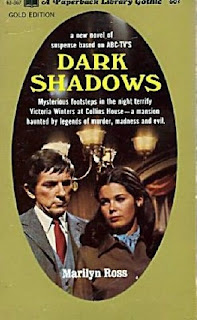
The cover of my edition clearly draws from the television series but what I found interesting is the cover has Jonathan Frid as Barnabas Collins and Alexander Moltke as Victoria Winters with a good grabber headline 'Mysterious Footsteps in the night terrify Victoria Winters at Collins House - a mansion haunted by legends of murder, madness and evil'.   Funny enough Barnabas Collins never appears in this story (apparently Willie Loomis had not unchained his coffin yet!), the picture is clearly taken in the Old House and in the text the name of the house on the hill in not 'Collinwood' but Collins House!  The picture itself looks like it comes from the post-1795 timeline when Barnabas bites Vicky (notice the scarf on her neck) to make her forget about her travel to 1795 and attempts to take her away (only to have an automobile accident and be 'cured' of his vampirism for a time by Dr. Lang).


According to the Paperback Library notes the first edition was printed with an illustrated cover (left) and then re-released in 1967 with a cover that had Victoria and Louis
Edmonds (Roger Collins) who is in the novel on it (right).

By the edition I have (from April 1969) the publishers were clearly using the popularity of the reluctant vampire Barnabas Collins to sell books (and the same would happen in later books with David Selby as Quentin Collins).


Interestingly the same picture from the eighth  edition (from a slightly different angle) was used on another volume in the series - Strangers at Collins House (to be reviewed in an upcoming post!)

The text of this novel is a slightly revised telling of Victoria Winters arriving in Collinsport from the television series.  Ross sets the gothic mood from the start with 'The Ominous clouds of the October afternoon had warned of bad weather on the way and now the threat was being fulfilled' (5) (an echo of the shows leitmotiv of their never being good weather at Collinwood!).  The same themes of Victoria coming to Collinsport from the New York Foundling Home (placed there years before and possibly linked to the Collins) having been mysteriously offered a position to be the governess of the rascal David Collins by the matriarch of 'Collins-House' - Elizabeth Collins Stoddard (who herself has not left 'Collins House' for 18 years!) is all taken from the original plot of the television series.   Just as on the television series we have the scene of Victoria talking to the waitress Maggie Evans who tells Victoria 'I mean Collins House is a real kookie place!' (7) and she introduces Victoria, and the reader, to the cast of characters living at the mansion on the hill.   Historical depth in the narrative is established when Maggie tells Victoria that Jeremiah Collins built Collins House in 1830 (although entirely inconsistent with the later story-line of Joshua Collins building the 'New House' in 1795-6).   Later Elizabeth Collins tells Victoria as she looks at his picture in the drawing room of 'Collins House' 'that's the man who built Collins House, my great-grandfather, Jeremiah Collins.  He was one of the most outstanding of our line.  It was he who began the fishing firm as well.' (23)   The 'confusion' between Jeremiah and Joshua Collins as the founding patriarch is clearly taken from the earlier story-lines of Dark Shadows before the 1795 story-line which established Joshua Collins (played brilliantly by Louis Edmonds) as the patriarch and father to Barnabas Collins. The first Collins to land from the Mayflower Isaac Collins is mentioned by Roger Collins as well (26).

In terms of history one of the most interesting passages Ross writes actually goes to the heart of why there is a curse on the Collins Family (long before Judah Zachary and Miranda DuVal were thought up) and it is around the place of all tragedy in Dark Shadows - Widows' Hill:


'Long before Jeremiah Collins built his mansion here, this was a sort of common gathering ground....In those days all the men of the village were fisherman and they would put out to sea for their catch and remain away often for days at a time.  Often storms would come up unexpectedly and since this was the highest point of land, their wives would come up here and watch anxiously for the boats to return...Only too often they never did come back to Collinsport.  And it was on this very hill that the wives realised it had come their turn to be widows.  Many tears had been shed on this very point of land......When Jeremiah bought the land he refused to let any of the townspeople use it and so the waiting wives would come here no more.  They cursed my ancestor and wished bad luck on all his kin.
It seems the curse had power.  None of the families have been happy here.
First to suffer Josette, the French bride for whom Jeremiah built Collins-House.  She threw herself from this cliff, down the full hundred feet to her death.  And there have been others since then.' (43 - my emphasis)

An interesting passage grounding the curse that would plague the Collins family in the Widows (who are heard in the television series wailing 'Elizabeth!') Also notice the use of Jeremiah/Josette story line which would become fleshed out and revised by the arrival of Barnabas and the 1795 story line (by the time this book was first published Josette has appeared as a ghost in the Old House in episode 70 broadcast on September 30, 1966).  

While most of the characters remain the same as the television series (although the caretaker Matthew Morgan is known as Matt Morgan!).  Carolyn is written very much with the vivacious actress Nancy Barrett in mind, David is his early series mischievous self and there are brief mentions of 'his mother' (hinting at the Lara Colllins Phoenix story line which clearly Ross did not want to engage with in this novel).  Roger comes off a bit more sleazy than the way Louis Edmonds played him (although both the book and television Roger both endulge in the drawing room brandy snifter).  There are brief peripheral appearances for more involved television characters such as Joe Haskell and the mysterious Burke Devlin (who Ross brings in towards the end of the novel as a possible link to Victoria's own secret).

For me the most interesting addition to this text is the character of Ernest Collins who is an entirely made-up character (and tells Victoria the curse story above).  This character does not appear anywhere in the television texts.  Ernest Collins is a classical violinist (musicians are a rarity in Dark Shadows saving the Victorian music hall singer Pansy Faye and Bruno Hess in the 1970 Parallel time story-line based on Daphne du Maurier's Rebecca) who drives most of the plot of the story that follows and serves as one of two love-interests for Victoria in this story (the other is the lawyer Will Grant).  Ernest has several secrets around his former wife who supposedly fell to her death from Widow's Hill which serves as one of the possible sources of the 'mysterious footsteps' that threatens Victoria during her stay at Collin House. Ross is clever here as 'he' juxtaposes this new story line with the one that would have been more familiar to those who watched the show - namely the possible reason why Elizabeth Stoddard Collins had not left 'Collins House; for 18 years - with the suspicion that she killed her husband, Paul Stoddard, and buried his body in the cellar (a no-go area for Victoria).

This first story is a good engaging Gothic thriller that certainly draws from Jane Eyre for its spine tingling conclusion (there is more in Collins House than meets the eye!).  Readers would have recognised many of the characters and story-lines from the television series but this text not only offers a novelisation of the early story-line of the television series but also builds new texts into the mythos (such as the character of Ernest Collins).   Ross also established Victoria Winters at 'Collins-House' and sets up further stories with the concluding paragraph -

'In the meantime she would go on as governess to David.  She would live on here in this quaint village and try to pry further into her secret past.  She could not easily forget her meeting with the mysterious Burke Devlin and wondered if he might be able to help her.  The Collins family had come to seem like her own - perhaps one day she would discover this to be true.  In any event, she looked forward to the weeks and months ahead.  She could cope with Roger.  Carolyn was loveable, and she could get to know the gracious Elizabeth Collins Stoddard better in the strange old mansion by the sea,  Collins House!' (159) 

And waiting on another part of the Estate behind a lion mouth guarded wall in the Collins Mausoleum  another member of the Collins family would eventually meet Victoria Winters - but that is for another posting!

My 50th Anniversary Dark Shadows exploration has begun!


Monday, 21 September 2015

Exploring The Dark Shadows Mythos CFP


Exploring The Dark Shadows Mythos
                    A Call for Papers                            

On June 27 1966 American television audiences encountered a unique daytime gothic soap-opera called Dark Shadows.  From the dream vision of a woman running on a beach, TV producer Dan Curtis and a dedicated team of writers and a stellar company of actors and actresses (many playing multiple roles in various time periods) created one of the most complex and pioneering liminal worlds for a television series which was focused on Collinwood – the great house on the hill and hosted ghosts, witches, vampires, werewolves and zombies. 

In its over 1200 daily episodes, Dark Shadows drew from some of the greatest tropes of horror, fantasy and weird literature as well as related science-fiction themes especially time travel and the inter-dimensions of parallel time.  The Dark Shadows mythos continues to be developed through movies, novels (including several written by original cast members such as Lara Parker), comic books, several other television reboots, games, fan fiction and most recently a continuing series of audio dramas.

In 2016 Dark Shadows will celebrate its 50th anniversary and in honour of this I would like to produce and [self] publish a volume of academic and reflective essays exploring the world of Dark Shadows.  The broad topics these papers could explore are:

·       The sources and literary tropes that were reimagined and repurposed for Dark Shadows story-lnes.
·       Barnabas Collins' place in the development of the vampire in modern horror texts.
·       The unique use of time-travel and parallel time in the narrative of Dark Shadows.
·       The Mythos of Dark Shadows and the role of trans-medial world-building through various texts.
·       The fan reception of Dark Shadows including the muli-generational interest in the show.
·       The fan-fiction of Dark Shadows and what this has added to the Dark Shadows mythos.

These are just some ideas that can be explored in this volume.

Paper Abstracts should be submitted by 1 December 2015 
Finished Papers by: 1 June 2016

Contact: Dr. Andrew Higgins


Sunday, 1 February 2009

Dark Shadows Reborn!!!


As a visitor to Wotan's Musings you may have noticed that Wotan has rather eclectic favs - in the TV front there is one that surpasses all others and that is Wotan's love of the late 60's - early 70's TV Gothic series - Dark Shadows.

For those of you unfamiliar with Dark Shadows here is a bit of a sample -


It was the brain child of TV Director Dan Curtis who had a dream of a woman being invited to be a governess in a strange New England mansion - this was developed into a story called "Shadows on the Wall" and then a daily TV "soap opera" that was broadcast in America on ABC at 4pm (Wotan vaguely remembers coming home from school and watching the original last couple of seasons). From its start (and you can enjoy all 1200+ episodes on DVD) there was a Gothic Jane Eyre feel to it -- an orphaned woman named Victoria Winters comes is invited to be governess to a rich New England Family called - The Collinses - who live in a large mansion high a top a hill called Collinwood. The matriarch of the house - Elizabeth Collins Stoddard has not left the mansion for 18 years and there may be a connection between her and the new governess Victoria (although interestingly this plot line in never really resolved). In its first year there was intrigue, a gothic feel and even the hint of a ghost - but when daytime ratings began to dip Dan Curtis has a masterstroke - lets go for it on the supernatural front - and after introducing a creature called the Phoenix who is reborn from the flames every 100 years - he went all out and introduced probably one of the most famous vampires of all time (after that other big one and Angel and long before the current Twilight) - Barnabas Collins who is released from his 200 year imprisonment by the tomb robber - Willie Loomis.


This started a cycle of stories that cover every much horror genre including the reluctant vampire, the werewolf, HP Lovecraft, Frankenstein and even Shirley Jackson's The Lottery. To tell the complete tale of the Collins family - Curtis employed time travel (with the same actors playing different parts) and even parallel time (the same time but based on you making different choices) - the budget was small and the camera never was stopped - the special effects for their time were quite creative and up to 1973 Dark Shadows was a unique show that launched the careers of such actors as Kate Jackson, David Selby and Laura Parker (as well as having such notable talent as Grayson Hall, Joan Bennett and Jonathan Frid as the tortured Barnabas. Two films followed, a 1990 revival series which re-told the Barnabas story with Ben Cross as the Vampire and now we hear that Johnny Depp, a great fan of the show, is working with Tim Burton on a movie version!!

Like Barnabas and Quentin this show does not die and over the years it has spawned books by Marilyn Ross (with such inventive titles as Barnabas, Quentin and the Scorpio Curse) as well as another series by Laura Parker - who played the wicked witch of Dark Shadows - Angelique, merchandise (including several copies of Barnabas's silver heads wolfs cane - one of which Wotan has in his living room). Web resource abound and there is even a wiki about Dark Shadows -


And now probably one of the most exciting occurrences as series of audio dramas featuring the original cast members with new stories and dramatic readings. These are being produced by Big Finish and Wotan has just finished listening to the first year of the series and several of the dramatic recordings - and there is a promise of more to come. There is a great blog by Darren Gross who is developing these shows and also working on the restoration of the second Dark Shadows movie - Night of Dark Shadows - which was edited extensively when it was released in the cinema in the 70;s.

There has never been, and I fear never will be again, such an original story like Dark Shadows and luckily for us there is all group of people who grew up with the show that now want it to stay alive and grow - and Wotan enjoys his many hours sitting in drawing room of Collinwood and hearing the wind come across Widows Hill and this haunting theme........

Blog Archive